


Useful articles

Ovarian Cyst: Robotic Cystectomy That Preserves the Ovary
Doctor's blog
sbdrmn
Direction: Robotic surgery · All services
An ovarian cyst is one of the most common findings on a pelvic ultrasound, and many women hear the word “cyst” and immediately think of surgery. In fact, most cysts disappear on their own, and an operation is needed only in particular situations. Below, in plain language: the types of cyst, when monitoring is enough, which symptoms are an emergency, how an ovary-sparing cystectomy is done, how laparoscopic and robotic approaches differ, and what it all means for a future pregnancy.
Contents
- What an ovarian cyst is and which types exist
- Functional cysts: when watchful waiting is enough
- Symptoms of an ovarian cyst
- Which cysts go away and which need surgery?
- Emergencies: ovarian torsion and a ruptured cyst
- How an ovarian cyst is assessed
- Cystectomy: removing the cyst while keeping the ovary
- Laparoscopic or robotic cystectomy: when is a robot chosen?
- Recovery after surgery and future pregnancy
- What to discuss with your doctor
- Frequently asked questions
What an ovarian cyst is and which types exist
An ovarian cyst is a sac filled with fluid or other material that forms inside an ovary or on its surface. Cysts are a very common finding in women of reproductive age, and most of them are harmless and disappear on their own. So seeing the word “cyst” on an ultrasound report does not automatically mean you need an operation. The key questions are what kind of cyst it is and whether it is likely to go away by itself.
Cysts fall into two broad groups. Functional cysts are linked to the menstrual cycle: a follicular cyst (a follicle that did not release its egg) and a corpus luteum cyst. Non-functional cysts do not go away on their own: a dermoid cyst (mature teratoma, which may contain fat, hair and other tissues), cystadenomas (benign growths filled with watery or mucous fluid) and an endometriotic cyst (endometrioma). Cysts caused by endometriosis are covered in detail in a separate article.
Functional cysts: when watchful waiting is enough
Follicular and corpus luteum cysts usually resolve by themselves within one to three menstrual cycles. So if a small, simple cyst is found (uniform fluid inside, a thin wall) and you have no significant symptoms, your doctor will usually suggest waiting and repeating the ultrasound after a few cycles, in the days just after a period. If the cyst has shrunk or disappeared, no further treatment is needed.
Research suggests that hormonal contraceptive pills do not make an existing functional cyst disappear any faster; they are more often used to reduce the chance of new cysts forming. Take any medicine only on your doctor’s advice.
Symptoms of an ovarian cyst
Many cysts cause no symptoms at all and are found by chance on a scan. When symptoms do occur, they may include a feeling of heaviness or a dull ache low in the abdomen on one side, pain during sex, bloating or a sense of fullness, needing to pass urine more often (if a large cyst presses on the bladder) and changes in the menstrual cycle. The same symptoms can be caused by other conditions, so a gynaecologist will establish the cause after an examination.
Which cysts go away and which need surgery?
| Type of cyst | Features | Usual approach |
|---|---|---|
| Follicular or corpus luteum cyst | Linked to the cycle; usually disappears on its own | Watchful waiting and a repeat scan |
| Dermoid cyst (mature teratoma) | Does not go away, grows slowly, can cause torsion | Cystectomy in most cases |
| Cystadenoma | Benign growth that gradually enlarges | Cystectomy or, depending on the situation, removal of the ovary |
| Endometrioma | Linked to endometriosis; a “chocolate” cyst | Surgery is not always needed — an individual decision |
| Cyst with suspicious features | Complex structure on ultrasound, solid areas, blood flow | Further tests and a plan based on the level of risk |
Surgery is usually discussed if a cyst persists or grows after several cycles, if it is large, if it causes pain or other symptoms, if it turns out to be a non-functional cyst such as a dermoid or cystadenoma, or if the ultrasound shows suspicious features.
Emergencies: ovarian torsion and a ruptured cyst
A cyst makes the ovary heavier and can cause it to twist around its own blood supply. This is called ovarian torsion, and it cuts off the blood flow to the ovary. When a cyst ruptures, fluid or blood spills into the abdomen. Both situations need urgent care, and with torsion, time is critical if the ovary is to be saved. More detail is in the article on ovarian rupture and cyst torsion.
If you develop sudden severe pain low in the abdomen, often on one side, with nausea and vomiting, a fever, dizziness, fainting or marked weakness, do not wait and do not mask the symptoms with painkillers — call 103 immediately.
How an ovarian cyst is assessed
The main test is a pelvic ultrasound, usually transvaginal. An experienced specialist assesses the size of the cyst, its wall and internal structure, and whether there are solid areas or blood flow. The international IOTA rules and the O-RADS system help to group cysts by level of risk. In selected cases a CA-125 blood test is done, but this marker can also rise with endometriosis, fibroids and even during a period, so on its own it does not make a diagnosis. This is explained in the article on the CA-125 test. An MRI scan may be recommended if needed.
Saba Darmon clinic has experienced gynaecologists, and ultrasound, laboratory tests and CT (MSCT) are available on site.
Cystectomy: removing the cyst while keeping the ovary
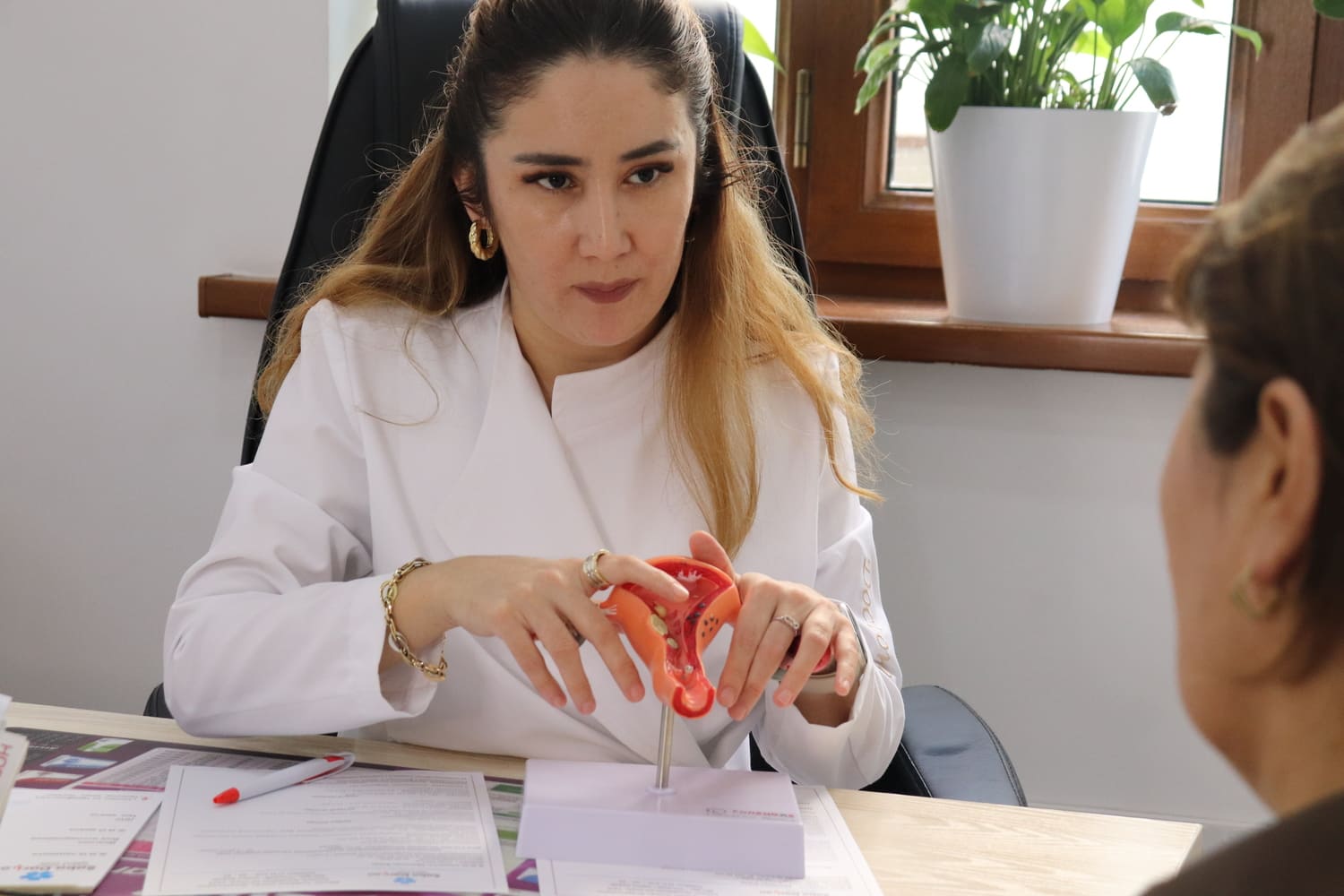
A cystectomy is an operation that removes only the cyst and preserves the healthy tissue of the ovary. For young women and those planning a family, it is the main surgical option. The surgeon opens the outer layer of the ovary, gently peels the cyst wall away from the healthy tissue and then stops any bleeding. The cyst is usually removed inside a special retrieval bag so that its contents do not spill into the abdomen, which is particularly important with a dermoid cyst. The removed tissue is sent for histology (examination under a microscope).
The ovary holds a store of eggs, and this store cannot be replenished. During surgery some healthy tissue can be damaged, especially if a lot of coagulation (sealing bleeding vessels with electrical energy) is used. That is why the surgeon handles the tissue as gently as possible, limits coagulation and, where needed, closes the ovary with fine stitches. You can read about assessing ovarian reserve with an AMH blood test in this article. After the menopause the approach may differ: depending on the level of risk, the whole ovary is sometimes removed.
Laparoscopic or robotic cystectomy: when is a robot chosen?
The standard way to remove an ovarian cyst is laparoscopy — keyhole surgery through several small incisions in the abdomen. Saba Darmon clinic performs laparoscopic removal of ovarian cysts, and there is a separate page on laparoscopic gynaecological surgery. The clinic also has the MedBot Toumai robotic system, so when appropriate a cystectomy may be carried out with robotic assistance.
| Approach | When it suits | Key features |
|---|---|---|
| Laparoscopic | Most cysts | Standard approach, small incisions, quick recovery |
| Robotic | Large or complex cysts, dense adhesions, obesity, when the ovary needs stitching | Magnified 3D view and wristed instruments that help with delicate dissection and suturing |
| Open | A very large cyst or special situations where cancer is suspected | Larger incision, longer recovery |
The robot is a tool in the surgeon’s hands: it can make gentle stitching of the ovary easier as an alternative to coagulation, but the outcome depends above all on the surgeon’s experience, and in straightforward cases laparoscopy is just as good. The approach is chosen by the gynaecological surgeon after assessment.
Recovery after surgery and future pregnancy
After minimally invasive cystectomy most women go home fairly soon. For a few days you may have abdominal pain, bloating and pain in the shoulder caused by the carbon dioxide gas used during surgery; this normally settles by itself. Walking early helps you recover. Most women return to light work within one to two weeks, and your doctor will tell you when you can lift heavier things and resume sex. Your first period afterwards may be slightly late or different from usual.
Because a cystectomy preserves the ovary, the possibility of pregnancy remains. Your doctor will advise when you can start trying, taking into account the extent of the operation and the histology result. For older women, for those with cysts on both sides or recurring cysts, and for women with an endometrioma, it is important to assess ovarian reserve in advance and not to put off plans for a family. Functional cysts can come back, so do not skip your follow-up scans.
What to discuss with your doctor
At your appointment, it is worth asking: what type of cyst do I have, and could it go away by itself; when should the scan be repeated; is surgery needed, and why; can the ovary be preserved; which approach is planned — laparoscopic or robotic; how might the operation affect my ovarian reserve; when can I plan a pregnancy. Bring your previous ultrasound reports and test results. At Saba Darmon clinic, after an examination the gynaecologists will explain the treatment options and agree the next steps with you. You can read about the gynaecology department and all areas of robotic surgery on this page.
Frequently asked questions
Can an ovarian cyst go away on its own?
Functional cysts — follicular and corpus luteum cysts — usually resolve by themselves within one to three menstrual cycles. So if a small simple cyst is found, your doctor will usually suggest waiting and repeating the ultrasound after a few cycles. Dermoid cysts, cystadenomas and endometriomas do not disappear on their own, and the gynaecologist makes a separate decision about them.
When does an ovarian cyst need surgery?
Surgery is usually discussed if a cyst persists or grows after several cycles, if it is large or painful, if it turns out to be a dermoid cyst or cystadenoma, or if the ultrasound shows suspicious features. In emergencies such as torsion or rupture, an operation is carried out urgently. In every case the gynaecologist decides on the basis of your examination and test results.
Does a cystectomy affect ovarian reserve?
It can, because a small amount of healthy tissue may be damaged along with the cyst. That is why the surgeon works as gently as possible and limits coagulation. The risk is higher with endometriomas and with cysts on both sides or recurring cysts. Before surgery, talk to your doctor about assessing your ovarian reserve with an AMH test, especially if you are planning a pregnancy.
Is robotic cystectomy better than laparoscopic surgery?
Not always. Laparoscopy is the standard way to remove an ovarian cyst and gives good results in most cases. A robot can help with large or complex cysts, dense adhesions and obesity, or when the ovary needs careful stitching. But the outcome depends mainly on the surgeon’s experience, and the approach is chosen by the gynaecological surgeon after a full assessment.
Can I get pregnant after a cystectomy?
Yes. A cystectomy preserves the ovary, so the possibility of pregnancy remains. Your doctor will advise when you can start trying, based on the extent of the operation and the histology result. For older women and those with an endometrioma, it is sensible to assess ovarian reserve beforehand and not to delay family plans for too long. Endometriomas are covered in a separate article.
More about robotic surgery:
- Robotic Surgery in Tashkent — all directions
- Robotic Surgery in Tashkent: the MedBot Toumai System
- Is Robotic Surgery Safe? 10 Questions
- Robotic Surgery vs Laparoscopy: What Is the Difference
- Preparing for Robotic Surgery: Step by Step
- Recovery After Robotic Surgery
- Bladder Cancer: Robotic Cystectomy
- Hernia: Robotic Repair
- Gallbladder: Robotic Cholecystectomy
- Who Is Not Suitable for Robotic Surgery
- Uterine and Cervical Cancer: Robotic Surgery
- Large Prostate Adenoma: TURP or Robotic Surgery
- Varicocele Surgery: Marmar or Robotic
- Kidney Removal: Robotic Nephrectomy
- Ectopic Pregnancy: Tube-Sparing Robotic Surgery
- Female Urinary Incontinence: TVT or Robotic Surgery
- Uterus Removal: Robotic Hysterectomy
- Hiatal Hernia and Reflux: Robotic Fundoplication
- Liver Tumour: Robotic Liver Resection
- Pancreatic Tumour: Robotic Resection
- Obesity Surgery: Robotic Sleeve Gastrectomy
- Diastasis Recti: Robotic Repair
- Colon Cancer: Robotic Hemicolectomy
- Anaesthesia and Pain Control in Robotic Surgery
- Pregnancy After Robotic Myomectomy
- Abdominal Adhesions: Robotic Adhesiolysis
- Obesity: Robotic Gastric Bypass
- Robotic Surgery in Gynaecology
- Robotic Prostatectomy
- Kidney Tumour: Robotic Partial Nephrectomy
- Colorectal Cancer: Robotic Surgery
- Uterine Fibroids: Robotic Surgery
- Endometriosis and Ovarian Cysts: Robotic Surgery
- What Is Telesurgery?
- Robotic Surgery in Older Adults
- Stomach Cancer: Robotic Gastrectomy
- Hydronephrosis: Robotic Pyeloplasty
- Pelvic Organ Prolapse: Robotic Sacrocolpopexy
- Adrenal Tumour: Robotic Adrenalectomy
Doctors for consultation
Our gynaecologists assess and monitor ovarian cysts and perform cystectomy. Our doctors in this field:





Book an appointment with a gynaecologist
Has an ultrasound shown an ovarian cyst? After assessment the gynaecologist will explain whether monitoring is enough or surgery is needed.
Call now — +998 71 210-30-30Contacts
Address: 7A/3 Nurafshon street, Tashkent
Phone: +998 71 210-30-30 · WhatsApp: +998 95 662-30-30
Opening hours: Monday–Saturday, 09:00–18:00
E-mail: