


Useful articles

Robotic Fundoplication: Hiatal Hernia and Reflux When Tablets Are Not Enough
Doctor's blog
sbdrmn
Direction: Robotic surgery · All services
Robotic fundoplication is an operation considered when a hiatal hernia and reflux (GERD) cannot be controlled with medicines. Constant heartburn, food coming back into the mouth and night-time coughing seriously affect quality of life. Below we explain how a hernia and reflux are linked, which tests may be needed, how Nissen and Toupet wraps differ, how robotic and laparoscopic surgery compare, and how to eat after the operation.
Contents
- Hiatal hernia and reflux: how they are linked
- Symptoms of reflux and hiatal hernia: when to see a doctor
- Tests: what is clarified before surgery
- When tablets are not enough: who needs fundoplication
- How fundoplication is done: Nissen versus Toupet
- Robotic or laparoscopic fundoplication: an honest comparison
- Eating after surgery
- Possible effects and the result
- When surgery is not the answer
- Frequently asked questions
Hiatal hernia and reflux: how they are linked
The oesophagus passes from the chest into the abdomen through a special opening in the diaphragm. If this opening widens and part of the stomach slides up into the chest, a hiatal hernia forms. The natural "valve" where the oesophagus meets the stomach then weakens, and acidic stomach contents flow back upwards — this is gastro-oesophageal reflux disease (GERD). Not every hernia causes reflux, and not every case of reflux involves a hernia, but the two are often found together.
Symptoms of reflux and hiatal hernia: when to see a doctor
- heartburn — a burning feeling behind the breastbone, especially after meals, when bending over and when lying down;
- sour or bitter belching, food coming back up into the mouth (regurgitation);
- night-time cough, a hoarse voice, a "lump" in the throat, erosion of tooth enamel;
- with a large hernia — feeling full quickly, pressure in the chest, breathlessness after eating.
Heartburn and the first steps of treatment are covered in a separate article.
If swallowing is getting steadily harder, or you have unexplained weight loss, vomiting with blood or black stools, get checked without delay. Severe chest pain, especially with sweating and breathlessness, may be a heart problem first and foremost: call 103 immediately.
Tests: what is clarified before surgery
The main test is gastroscopy (upper endoscopy): it shows the lining of the oesophagus, the degree of oesophagitis and the size of the hernia, and a biopsy can be taken if needed. How to prepare for it is explained here. If surgery is being planned, further tests may be needed:
- oesophageal manometry — measures the strength of the oesophageal contractions; this matters when choosing the type of operation;
- 24-hour pH monitoring — confirms that the symptoms really come from acid reflux;
- contrast X-ray (barium swallow) — shows the anatomy of the hernia and how the oesophagus empties.
Your doctor decides which of these tests you actually need.
When tablets are not enough: who needs fundoplication
For most patients reflux can be controlled with lifestyle changes (an early evening meal, raising the head of the bed, losing weight, stopping smoking) and acid-reducing medicines. Surgery is usually discussed when:
- symptoms continue despite treatment, especially regurgitation of food;
- the patient does not want to take medicines for life, or they cause side effects;
- the hernia is large, with a significant part of the stomach in the chest;
- there are complications: severe oesophagitis, narrowing of the oesophagus, repeated aspiration.
How fundoplication is done: Nissen versus Toupet
During the operation the hernia is returned to the abdomen, the widened opening is narrowed with stitches, and then the upper part of the stomach (the fundus) is wrapped around the lower oesophagus to create a new "valve".
| Technique | How the wrap is made | Key feature |
|---|---|---|
| Nissen | Complete, 360° | Stops reflux very effectively; a slightly higher chance of temporary swallowing difficulty and trouble passing wind |
| Toupet | Partial, posterior 270° | Often chosen when oesophageal contractions are weak; swallowing difficulty and bloating may be less |
The choice depends on test results and the surgeon’s assessment; there is no universal "best" technique.
Robotic or laparoscopic fundoplication: an honest comparison
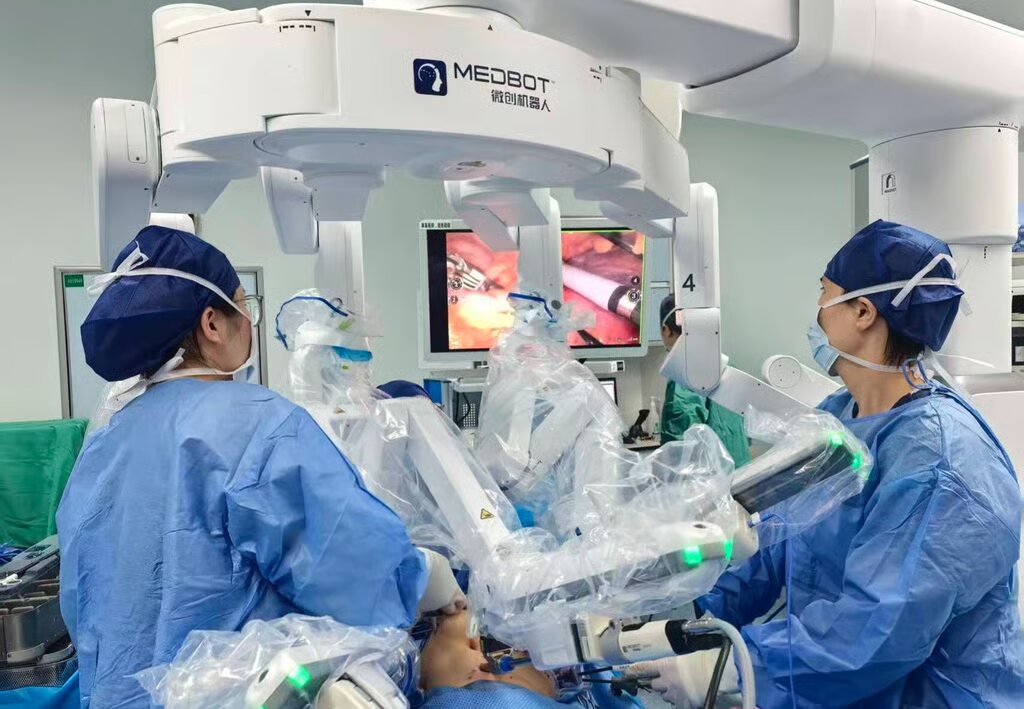
Fundoplication has been performed laparoscopically for many years, and this is the standard; laparoscopic fundoplication is also performed at the clinic. Saba Darmon clinic has the MedBot Toumai robotic system, and this operation can be performed with robotic assistance. The robot provides a magnified 3D view and articulated instruments in the narrow, deep space beneath the diaphragm — useful with a large or recurrent hernia, when the oesophagus has to be mobilised well, in obesity, or with adhesions from earlier surgery.
To be plain: for an ordinary small hernia, laparoscopic and robotic results are similar. The surgeon chooses the method after assessment, and if necessary there is also a chance of switching to open surgery. The difference between the two approaches is explained in this article.
Eating after surgery
- the first days — liquids and very soft food;
- the next few weeks — soft food: porridge, purées, thin soups, yoghurt, steamed minced dishes; swelling around the wrap can make swallowing harder;
- small portions, eaten slowly and chewed well;
- temporarily limit fizzy drinks, fresh bread, dry meat and hard pieces of food;
- then return gradually to a normal diet — the surgeon will give you a schedule.
Possible effects and the result
After surgery temporary difficulty swallowing is common — it usually settles within a few weeks. Bloating, being unable to belch, more wind and feeling full early can also occur. Rarely, symptoms last longer and further treatment (for example, endoscopic dilatation) is needed. Over time the hernia can come back, especially a large one — which is why weight control matters; you may also want to read about managing excess weight.
Most patients find that heartburn and regurgitation fall noticeably after fundoplication, but the result also depends on choosing the right operation, following the eating rules and keeping weight under control.
When surgery is not the answer
- the symptoms come not from reflux but from another cause (functional dyspepsia, the gallbladder, the heart) — pH monitoring helps tell them apart;
- medicines have no effect at all — this can be a reason to review the diagnosis;
- oesophageal movement is severely disturbed (for example, achalasia) — a different treatment is needed;
- a small hernia without symptoms — it does not need treatment;
- serious other illnesses make the risk of anaesthesia high.
All areas of robotic surgery are listed on this page.
Frequently asked questions
Can a hiatal hernia go away without surgery?
The hernia itself does not close on its own, but a small hernia without symptoms does not need treatment. Reflux symptoms are usually controlled with lifestyle changes and medicines.
Will I need tablets after fundoplication?
Most patients stop acid-reducing medicines or take them far less often, but not everyone. Some may need them again over time — the doctor decides this during follow-up.
When can I eat normal food after the operation?
Soft food is usually advised for a few weeks, followed by a gradual return to a normal diet. The surgeon gives the exact schedule.
Nissen or Toupet — which is better?
There is no universal answer. Nissen stops reflux more completely, while Toupet may cause less trouble with swallowing and wind; the choice depends on test results and the surgeon’s assessment.
Is robotic fundoplication risky?
Like any operation it has risks: anaesthesia, bleeding and, rarely, injury to the oesophagus or stomach. Robotic and laparoscopic approaches have a similar risk profile; read about preparation in this article.
How many days will I stay in hospital?
Most often 1–3 days; longer with a large hernia or other illnesses.
Will I be able to burp after surgery?
Some patients find burping difficult at first, and this usually eases with time. Avoiding fizzy drinks and eating slowly helps.
More about robotic surgery:
- Robotic Surgery in Tashkent — all directions
- Robotic Surgery in Tashkent: the MedBot Toumai System
- Is Robotic Surgery Safe? 10 Questions
- Robotic Surgery vs Laparoscopy: What Is the Difference
- Preparing for Robotic Surgery: Step by Step
- Recovery After Robotic Surgery
- Bladder Cancer: Robotic Cystectomy
- Hernia: Robotic Repair
- Gallbladder: Robotic Cholecystectomy
- Who Is Not Suitable for Robotic Surgery
- Uterine and Cervical Cancer: Robotic Surgery
- Large Prostate Adenoma: TURP or Robotic Surgery
- Varicocele Surgery: Marmar or Robotic
- Kidney Removal: Robotic Nephrectomy
- Ectopic Pregnancy: Tube-Sparing Robotic Surgery
- Female Urinary Incontinence: TVT or Robotic Surgery
- Uterus Removal: Robotic Hysterectomy
- Liver Tumour: Robotic Liver Resection
- Pancreatic Tumour: Robotic Resection
- Obesity Surgery: Robotic Sleeve Gastrectomy
- Diastasis Recti: Robotic Repair
- Colon Cancer: Robotic Hemicolectomy
- Anaesthesia and Pain Control in Robotic Surgery
- Pregnancy After Robotic Myomectomy
- Robotic Prostatectomy
- Kidney Tumour: Robotic Partial Nephrectomy
- Colorectal Cancer: Robotic Surgery
- Uterine Fibroids: Robotic Surgery
- Endometriosis and Ovarian Cysts: Robotic Surgery
- What Is Telesurgery?
- Robotic Surgery in Older Adults
- Stomach Cancer: Robotic Gastrectomy
- Hydronephrosis: Robotic Pyeloplasty
- Pelvic Organ Prolapse: Robotic Sacrocolpopexy
- Adrenal Tumour: Robotic Adrenalectomy
Doctors for consultation
Operations for hiatal hernia and reflux are performed by our surgeons. Our doctors in this field:




Book an appointment with a surgeon or gastroenterologist
Heartburn continuing despite medicines? After assessment the doctor will explain whether surgery is needed.
Call now — +998 71 210-30-30Contacts
Address: 7A/3 Nurafshon street, Tashkent
Phone: +998 71 210-30-30 · WhatsApp: +998 95 662-30-30
Opening hours: Monday–Saturday, 09:00–18:00
E-mail: