


Useful articles

Robotic Sleeve Gastrectomy: Obesity Surgery — Who Qualifies, Risks and Life After
Doctor's blog
sbdrmn
Direction: Robotic surgery · All services
Robotic sleeve gastrectomy is a version of the stomach-reducing operation for obesity that is performed with robotic assistance. Many people struggle with their weight for years through diets and exercise, only to see it return. In such cases bariatric surgery may be discussed. Below, in plain language: who the operation suits, which tests are needed, how robotic, laparoscopic and open approaches differ, the main risks, and why follow-up after surgery lasts for life.
Contents
- What obesity surgery is and who needs it
- Sleeve gastrectomy and gastric bypass: what is the difference?
- Preparing for surgery: which tests are needed?
- Robotic, laparoscopic or open: an honest comparison
- How the day of the operation goes
- Risks and complications of sleeve gastrectomy
- After a sleeve gastrectomy: recovery and lifelong follow-up
- Frequently asked questions
What obesity surgery is and who needs it
Bariatric (metabolic) surgery is a group of operations that change the anatomy of the stomach and bowel and, in doing so, reset portion size, hunger hormones and metabolism. It is not a cosmetic procedure: the main goal is to reduce the burden of diseases linked to obesity — type 2 diabetes, high blood pressure, sleep apnoea, joint pain and fatty liver disease — and to improve quality of life.
International guidelines give the following general orientation, but the final decision is made by the doctor after a full assessment:
- a body mass index (BMI) of about 40 or higher — even without other conditions;
- a BMI of about 35 or higher — if there is type 2 diabetes, high blood pressure, sleep apnoea or another serious complication of obesity;
- several attempts at diet, physical activity and medication have not produced a lasting result;
- the patient is ready to follow the eating rules after surgery and to attend follow-up for life.
BMI is calculated by dividing weight in kilograms by height in metres squared. For example, a person who is 1.70 m tall and weighs 116 kg has a BMI of roughly 40. In some cases, especially with severe diabetes, the thresholds may be considered differently — this is decided jointly by the endocrinologist and the surgeon.
There are also situations in which surgery is usually not recommended: untreated severe mental health conditions, active alcohol or drug dependence, and serious heart or lung disease that sharply increases the risk of an operation. The doctor assesses these separately.
Sleeve gastrectomy and gastric bypass: what is the difference?
In a sleeve gastrectomy (longitudinal resection of the stomach) most of the stomach is removed, and what remains takes the shape of a narrow tube, or “sleeve”. The stomach becomes small, less of the hunger hormone ghrelin is produced, and the person feels full after a small portion. The route of the bowel does not change, so the operation is technically simpler.
In a gastric bypass (Roux-en-Y) a small pouch is created from the upper part of the stomach and joined directly to the small intestine; food bypasses most of the stomach and the duodenum. This option is often chosen for severe reflux or severe diabetes, but the risk of vitamin and mineral deficiency is higher. Both operations are described in detail in our article on sleeve and bypass surgery.
Preparing for surgery: which tests are needed?
Bariatric surgery is not a decision made in a single day. Preparation can take several weeks and involves several specialists:
- an endocrinologist — rules out hormonal causes (thyroid, adrenal glands and others) and adjusts diabetes treatment;
- gastroscopy (upper endoscopy) — a look at the oesophagus and stomach for reflux, hiatus hernia, ulcers or Helicobacter pylori; the result matters when choosing between a sleeve and a bypass;
- abdominal ultrasound — to check for gallstones and assess the liver;
- a psychologist — to assess eating behaviour, motivation, binge eating and depression;
- a dietitian — a pre-operative diet: usually a few weeks of a low-calorie, protein-rich plan shrinks the liver and makes the operation safer;
- blood tests, an ECG, a cardiologist and a lung specialist if needed (for sleep apnoea), and a review by the anaesthetist.
Stopping smoking well before surgery is strongly advised: smoking impairs the healing of the staple line and increases the risk of ulcers. The general preparation steps are gathered in this article.
Robotic, laparoscopic or open: an honest comparison
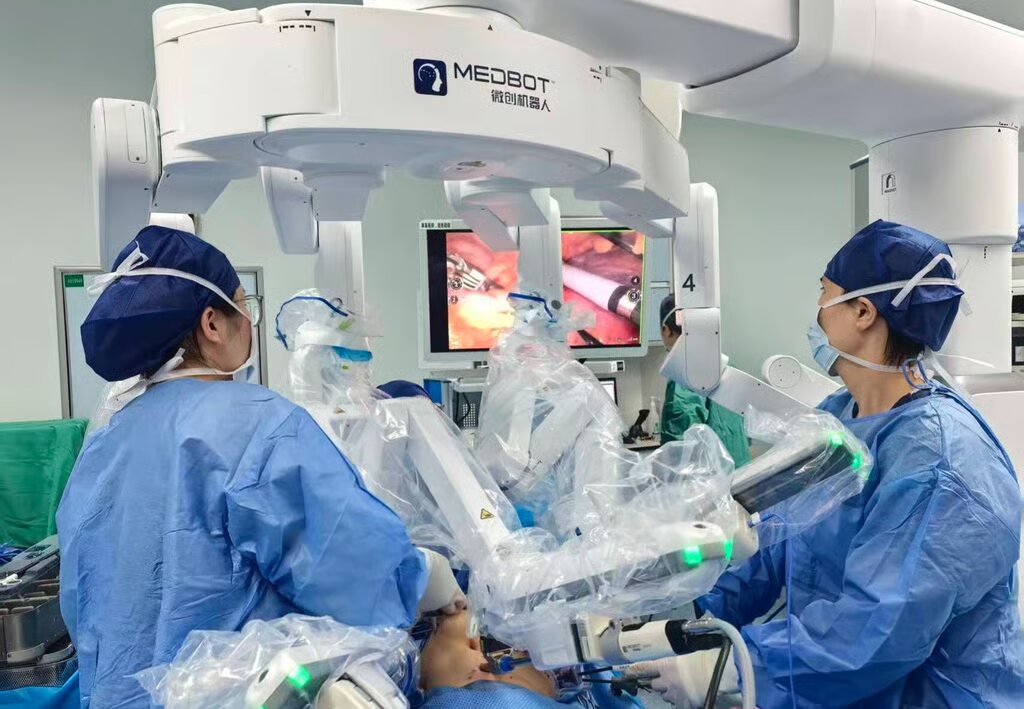
Saba Darmon clinic has the MedBot Toumai robotic system, and a sleeve gastrectomy can be performed with robotic assistance — the surgeon chooses the method after assessment. To be plain: laparoscopy remains the worldwide standard in bariatric surgery today. It is well studied and gives very good results in most patients.
| Method | When it suits | Key feature |
|---|---|---|
| Laparoscopic | Most first-time sleeve and bypass operations | The standard approach; small ports, quick recovery, the largest body of evidence |
| Robotic | Very high BMI, a thick abdominal wall, repeat (revision) surgery, complex suturing | Magnified 3D view, articulated instruments, tremor filtering; the operation may take a little longer |
| Open | Rarely used now: dense adhesions or certain complications | Large incision, more pain, longer recovery |
The robot’s advantage shows when a thick abdominal wall restricts the movement of instruments, and when working among adhesions from earlier operations. In a routine first-time sleeve gastrectomy, laparoscopy gives results that are no worse, so the robot is not needed by everyone. The general difference between the two approaches is explained in a separate article. In any minimally invasive operation there remains a chance of switching to open surgery if safety requires it.
How the day of the operation goes
- nothing to eat from the evening before; in the morning the anaesthetist examines you once more;
- general anaesthesia; several small ports are made in the abdomen;
- a special calibration tube is passed into the stomach, and the stomach is divided along it with a stapling device; the staple line is tested to make sure it is watertight;
- the operation usually takes a few hours;
- a few hours later you are helped to stand and walk — important for preventing blood clots; compression stockings are worn on the legs;
- the next day small sips of fluid are allowed; the hospital stay is usually a few days.
Risks and complications of sleeve gastrectomy
In modern conditions bariatric surgery is relatively safe, but it would be untrue to say that it carries no risk at all. The main risks are:
- a staple-line leak — uncommon, but the most serious complication; it usually shows itself in the first days or weeks with fever, a fast heart rate and abdominal pain;
- bleeding — from the staple line or into the abdomen;
- reflux (heartburn) — may appear or worsen after a sleeve; this is why patients with severe reflux are often offered a bypass instead;
- blood clots and pulmonary embolism, gallstones during the period of rapid weight loss, and vitamin and iron deficiency.
If after surgery you develop a fever, a fast heart rate, increasing pain in the abdomen or left shoulder, shortness of breath, vomiting blood or vomiting that will not stop, contact a doctor at once; if you feel seriously unwell, call 103 immediately.
After a sleeve gastrectomy: recovery and lifelong follow-up
The operation is the start of treatment, not the end of it. Eating is built up step by step: first clear fluids, then purées, then soft and finally ordinary food. The key rules are to eat small amounts slowly, chew thoroughly, avoid drinking with meals and get enough protein every day. A detailed menu and lifestyle advice are in our article on diet and life after a sleeve.
Most patients take vitamin and mineral supplements for life — which ones is decided by the doctor based on blood tests. In the first year follow-up visits are frequent, and after that at least once a year: weight, blood tests (haemoglobin, iron, vitamins B12 and D) and, if needed, gastroscopy. Pregnancy is usually best postponed until weight has stabilised, most often for more than a year. Physical activity and psychological support play a big part in preventing weight regain. General advice on recovery after robotic surgery is here, and all areas of robotic surgery are listed on this page.
Frequently asked questions
How much weight do you lose after a sleeve gastrectomy?
Results vary from person to person. Most people lose a large share of their excess weight over one to two years, but this depends on diet, activity and the starting point. The doctor discusses realistic expectations after assessment.
Is a robotic sleeve gastrectomy better than a laparoscopic one?
Not always. In a routine case the results are similar, and laparoscopy is considered the standard. The robot may be more convenient with a very high BMI or a repeat operation; the surgeon chooses the method after assessment.
Can I have bariatric surgery with a BMI below 35?
Usually diet, activity and medication are considered first in this situation. In some cases, especially with severe type 2 diabetes, metabolic surgery may be discussed. The endocrinologist’s approach is described in our article on managing obesity.
Can weight come back after a sleeve gastrectomy?
It can, especially if the eating rules and physical activity are forgotten. Over time the stomach stretches a little. Regular follow-up and working with a dietitian reduce this risk.
Sleeve or gastric bypass: which is better?
There is no single answer for everyone. A sleeve is technically simpler, while a bypass may be preferable with severe reflux and in some cases of diabetes. The choice is based on the gastroscopy result, other conditions and the patient’s own view.
When can I return to work after weight loss surgery?
Most people can go back to desk work after one to three weeks. Heavy physical work and strain on the abdominal muscles are restricted for about six weeks; your doctor will give the exact time.
Does diabetes go away after bariatric surgery?
In many patients blood sugar control improves markedly, and some need fewer medicines or none at all. This does not happen to everyone, so follow-up with an endocrinologist continues.
More about robotic surgery:
- Robotic Surgery in Tashkent — all directions
- Robotic Surgery in Tashkent: the MedBot Toumai System
- Is Robotic Surgery Safe? 10 Questions
- Robotic Surgery vs Laparoscopy: What Is the Difference
- Preparing for Robotic Surgery: Step by Step
- Recovery After Robotic Surgery
- Bladder Cancer: Robotic Cystectomy
- Hernia: Robotic Repair
- Gallbladder: Robotic Cholecystectomy
- Who Is Not Suitable for Robotic Surgery
- Uterine and Cervical Cancer: Robotic Surgery
- Large Prostate Adenoma: TURP or Robotic Surgery
- Varicocele Surgery: Marmar or Robotic
- Kidney Removal: Robotic Nephrectomy
- Ectopic Pregnancy: Tube-Sparing Robotic Surgery
- Female Urinary Incontinence: TVT or Robotic Surgery
- Uterus Removal: Robotic Hysterectomy
- Hiatal Hernia and Reflux: Robotic Fundoplication
- Liver Tumour: Robotic Liver Resection
- Pancreatic Tumour: Robotic Resection
- Diastasis Recti: Robotic Repair
- Colon Cancer: Robotic Hemicolectomy
- Anaesthesia and Pain Control in Robotic Surgery
- Pregnancy After Robotic Myomectomy
- Robotic Prostatectomy
- Kidney Tumour: Robotic Partial Nephrectomy
- Colorectal Cancer: Robotic Surgery
- Uterine Fibroids: Robotic Surgery
- Endometriosis and Ovarian Cysts: Robotic Surgery
- What Is Telesurgery?
- Robotic Surgery in Older Adults
- Stomach Cancer: Robotic Gastrectomy
- Hydronephrosis: Robotic Pyeloplasty
- Pelvic Organ Prolapse: Robotic Sacrocolpopexy
- Adrenal Tumour: Robotic Adrenalectomy
Doctors for consultation
Consultations and operations in obesity surgery are carried out by our general surgeons. Our doctors in this field:




Book a consultation with a surgeon
Whether obesity surgery suits you, the doctor will explain every option after assessment.
Call now — +998 71 210-30-30Contacts
Address: 7A/3 Nurafshon street, Tashkent
Phone: +998 71 210-30-30 · WhatsApp: +998 95 662-30-30
Opening hours: Monday–Saturday, 09:00–18:00
E-mail: