


Useful articles

Uterine and Cervical Cancer: What to Know About Robotic Surgery
Doctor's blog
sbdrmn
Direction: Robotic surgery · All services
"Uterine cancer" covers two distinct diseases — cancer of the endometrium and cancer of the cervix. The route to diagnosis, the extent of surgery and the choice of approach differ between them. Below: those differences, and what the robotic approach adds.
Contents
Two different cancers, two different paths
The phrase "uterine cancer" actually covers two distinct diseases, and they should not be conflated:
- Endometrial cancer — arises in the lining of the uterus. It most often announces itself as bleeding after the menopause, so it tends to be found comparatively early.
- Cervical cancer — arises in the lining of the cervix, driven mainly by persistent high-risk HPV infection. It can remain silent for a long time.
Both the extent of surgery and the choice of approach follow from this distinction.
How the diagnosis is made
No operation is carried out on an ultrasound report alone. The diagnosis is confirmed by histology: for the endometrium, material from the uterine cavity; for the cervix, colposcopy and biopsy. Imaging is then added to assess how far the disease has spread.
Any bleeding after the menopause always warrants investigation. It is not an "age-related change" and it is not something to wait out.
What the extent of surgery involves
For endometrial cancer the uterus is usually removed together with the ovaries and tubes, with lymph nodes assessed where needed. For cervical cancer the extent depends on the stage and may involve radical hysterectomy — removing the uterus along with surrounding tissue.
Assessing the lymph nodes carries particular weight: it shapes the treatment plan. That is why the histology result after surgery is awaited before the next step is planned.
Why the robot is discussed for these operations
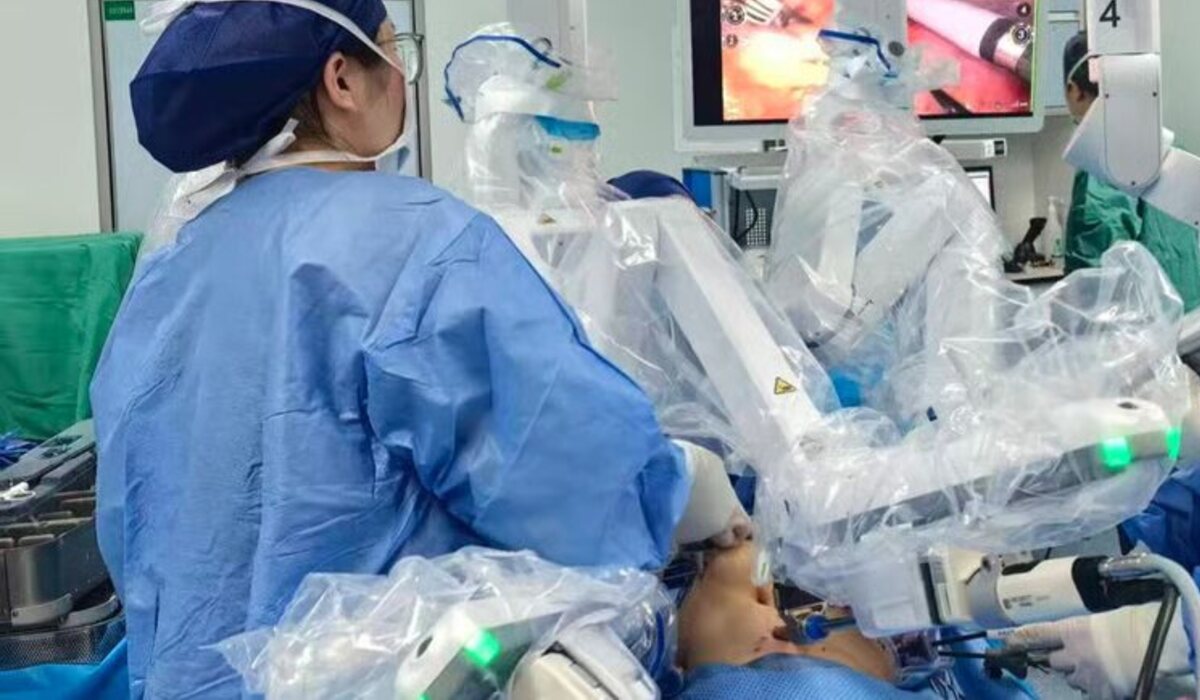
The pelvis is a confined, deep space. The ureters, bladder, rectum and major vessels all lie close around the uterus. In a radical hysterectomy they must be separated with care.
An articulated instrument and a three-dimensional view help precisely in these conditions, and add precision when working with lymph nodes. The extent does not change, however — the scale of surgery is set by the stage, not by the method.
Important: the choice of approach in cervical cancer has been the subject of a distinct professional debate, and decisions today are made individually, together with an oncologist. There is therefore no general answer to "which method is better" — only an answer for your particular situation.
Ovaries and the question of fertility
This conversation belongs before the operation. In younger patients with early-stage disease, preserving the ovaries or options that retain the possibility of having children are discussed in selected cases.
If the ovaries are removed before the natural menopause, surgical menopause follows — its effects and the plan for follow-up are explained in advance.
After the operation
Following a port-based procedure patients are usually up sooner and spend less time in hospital. Lifting, hot baths and intimacy are restricted for several weeks — your doctor will give exact timings.
Whether further treatment is needed — radiotherapy or drug therapy — is decided on the histology result, and the follow-up schedule is built around it as well.
A word on prevention
Cervical cancer is one of the few cancers that can be prevented: HPV vaccination and regular screening (cytology and HPV testing) allow the disease to be intercepted before it begins. There is a separate article on ovarian reserve and women's health; preparation for surgery is covered here.
Frequently asked questions
Is bleeding after the menopause always cancer?
No, there are various causes. But the sign always warrants investigation, because this is precisely how endometrial cancer is found early.
If the uterus is removed, are the ovaries removed too?
That is a separate decision. In endometrial cancer they are usually removed together; in other situations preservation is discussed given age and stage.
Are results better with the robot?
Results are determined mainly by stage and the completeness of removal, not by the method. The robot eases work in a confined space but does not change the extent.
Will radiotherapy be needed after surgery?
That depends on the histology result. The decision is made with an oncologist once the assessment is complete.
Will I still be able to have children?
In selected early-stage cases, fertility-sparing options are discussed. This conversation must take place before surgery.
Can cervical cancer be prevented?
Yes — HPV vaccination and regular screening are regarded as a proven way to prevent this cancer.
More about robotic surgery:
- Robotic Surgery in Tashkent — all directions
- Robotic Surgery in Tashkent: the MedBot Toumai System
- Is Robotic Surgery Safe? 10 Questions
- Robotic Surgery vs Laparoscopy: What Is the Difference
- Preparing for Robotic Surgery: Step by Step
- Recovery After Robotic Surgery
- Bladder Cancer: Robotic Cystectomy
- Hernia: Robotic Repair
- Gallbladder: Robotic Cholecystectomy
- Who Is Not Suitable for Robotic Surgery
- Large Prostate Adenoma: TURP or Robotic Surgery
- Varicocele Surgery: Marmar or Robotic
- Kidney Removal: Robotic Nephrectomy
- Ectopic Pregnancy: Tube-Sparing Robotic Surgery
- Female Urinary Incontinence: TVT or Robotic Surgery
- Uterus Removal: Robotic Hysterectomy
- Hiatal Hernia and Reflux: Robotic Fundoplication
- Liver Tumour: Robotic Liver Resection
- Pancreatic Tumour: Robotic Resection
- Obesity Surgery: Robotic Sleeve Gastrectomy
- Diastasis Recti: Robotic Repair
- Colon Cancer: Robotic Hemicolectomy
- Anaesthesia and Pain Control in Robotic Surgery
- Pregnancy After Robotic Myomectomy
- Robotic Prostatectomy
- Kidney Tumour: Robotic Partial Nephrectomy
- Colorectal Cancer: Robotic Surgery
- Uterine Fibroids: Robotic Surgery
- Endometriosis and Ovarian Cysts: Robotic Surgery
- What Is Telesurgery?
- Robotic Surgery in Older Adults
- Stomach Cancer: Robotic Gastrectomy
- Hydronephrosis: Robotic Pyeloplasty
- Pelvic Organ Prolapse: Robotic Sacrocolpopexy
- Adrenal Tumour: Robotic Adrenalectomy
Doctors for consultation
In these cases a gynaecologist and an oncological surgeon work together. Our doctors in this field:




Is robotic surgery right for you?
Book an appointment with a surgeon and bring your test results: the doctor will compare the options and recommend the safest one for you.
Call now — +998 71 210-30-30Contacts
Address: 7A/3 Nurafshon street, Tashkent
Phone: +998 71 210-30-30 · WhatsApp: +998 95 662-30-30
Opening hours: Monday–Saturday, 09:00–18:00
E-mail: