


Useful articles

Hernia: Robotic Repair and Mesh Reinforcement
Doctor's blog
sbdrmn
Direction: Robotic surgery · All services
A hernia is one of the most common surgical problems, and only an operation resolves it. Below: the types of hernia, why the defect is reinforced with mesh, when the robotic approach has the edge, and how recovery goes.
Contents
- What a hernia is and why it will not heal by itself
- When waiting is not an option
- Types of hernia and the principle of repair
- What the robot changes in hernia repair
- When the robot comes up more often
- The day of surgery and the first days
- Lifting and going back to work
- What to clarify with your doctor
- Frequently asked questions
What a hernia is and why it will not heal by itself
A hernia is part of an internal organ pushing through a weak spot in the abdominal wall. The weakness may be present from birth, or acquired — through an old surgical scar, heavy lifting or a chronic cough.
One fact matters above all: a defect in the abdominal wall does not close on its own. A truss may hold the bulge back for a while, but it does not repair the defect. Surgery is the only treatment for a hernia.
When waiting is not an option
If the bulge becomes firm and painful and can no longer be pushed back, with nausea or vomiting, this may indicate strangulation. That situation needs emergency medical care without delay.
Planned surgery, by contrast, is not urgent — but postponing it serves no purpose: the defect widens over time and the operation becomes harder.
Types of hernia and the principle of repair
- Inguinal — the most common, particularly in men;
- Umbilical — around the navel;
- Epigastric — along the midline of the abdomen;
- Incisional — at the site of a previous incision;
- Hiatus hernia — at the junction of chest and abdomen, often presenting as heartburn.
In modern surgery the defect is almost always reinforced with mesh: simple stitching carries a higher chance of recurrence. The mesh becomes incorporated into tissue and supports the wall long term.
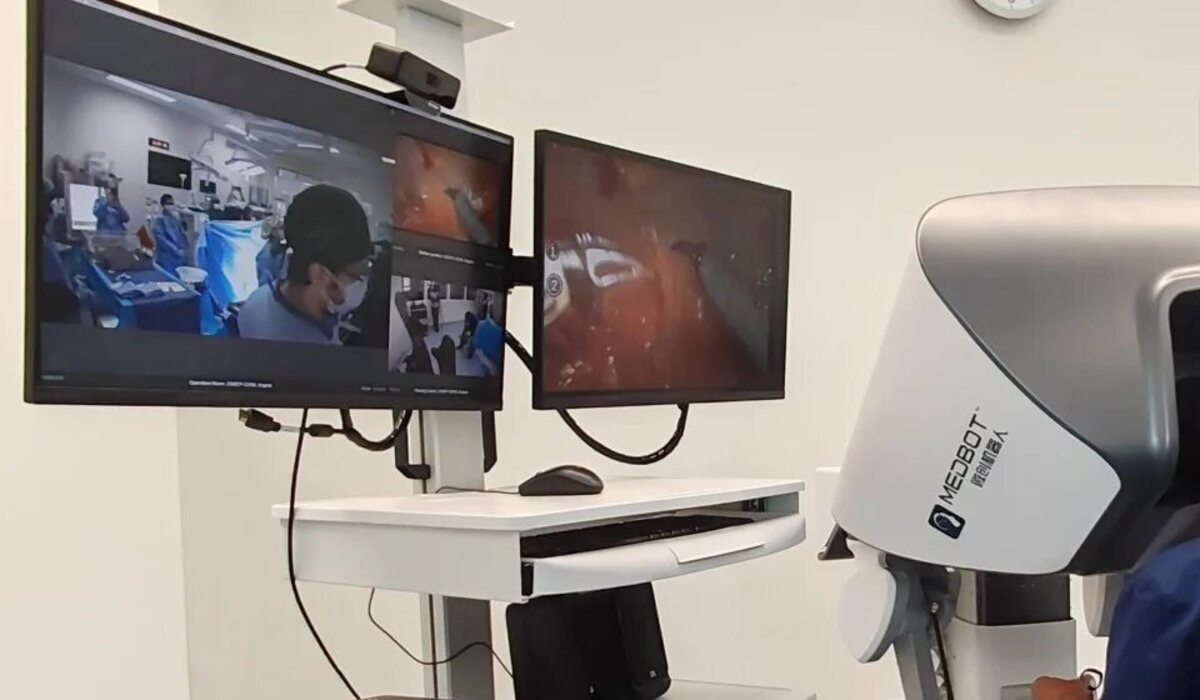
What the robot changes in hernia repair
The quality of a hernia repair depends largely on how the mesh is laid and fixed. It must be spread flat, overlap the defect generously, and the layers closed — all of which calls for small, precise movements.
The articulated robotic instrument helps most at this stage: suturing the abdominal wall from the inside at an awkward angle is markedly harder with a straight laparoscopic instrument. That is why this approach is discussed more often for complex and recurrent hernias.
It is worth stating plainly: for a simple primary inguinal hernia, a well-performed laparoscopic repair is enough. The robot is not obligatory here — its advantage shows in the difficult cases.
When the robot comes up more often
- recurrent hernia — scarring and adhesions from earlier surgery;
- large incisional hernia requiring reconstruction of the abdominal wall;
- bilateral hernia;
- hiatus hernia — a deep area needing many sutures.
The day of surgery and the first days
The operation is done under general anaesthesia. Camera and instruments go in through ports, the defect is identified, and the mesh is positioned and fixed. For planned repairs most patients go home within a few days — your surgeon will give the exact expectation.
Walking is encouraged from the first days. Mild swelling and bruising around the ports are expected. After inguinal repair there is sometimes swelling around the scrotum, which settles gradually.
Lifting and going back to work
This is the most common question. The general rule: lifting and abdominal strain are restricted for several weeks — that is the period when firm tissue forms around the mesh. Your surgeon will give specific limits based on the operation.
Desk work is usually possible considerably earlier than physical work. Return to sport is staged and begins only with your doctor's approval.
What lowers the chance of recurrence: losing excess weight, stopping smoking (coughing raises intra-abdominal pressure), treating constipation and lifting with proper technique.
What to clarify with your doctor
The type and size of the hernia; which mesh and fixation are planned; whether conversion to open surgery is possible; which tests anaesthesia requires; after how many weeks lifting is allowed. The list of pre-operative tests is set out in a separate article; on pain after surgery and early mobilisation, see here.
Frequently asked questions
Can a hernia be treated without surgery?
No. The defect in the abdominal wall does not close on its own, and a truss only holds the bulge temporarily. Surgery is the only treatment.
Does the mesh stay in the body, and can it be felt?
Yes, the mesh stays permanently and becomes incorporated into tissue. As a rule it is not felt over time.
Is robotic surgery more reliable?
The robot does not improve the result automatically. It makes mesh placement easier in complex and recurrent hernias; for simple cases laparoscopy is enough.
How soon can I lift weights?
Restrictions usually last several weeks. Your surgeon sets the exact period according to the operation performed.
Can a hernia come back?
Yes, that possibility always exists. Excess weight, smoking, constipation and lifting too early all increase it.
Can a bilateral hernia be repaired in one operation?
In many cases yes — port-based approaches allow both sides to be dealt with in a single procedure. The surgeon decides.
More about robotic surgery:
- Robotic Surgery in Tashkent — all directions
- Robotic Surgery in Tashkent: the MedBot Toumai System
- Is Robotic Surgery Safe? 10 Questions
- Robotic Surgery vs Laparoscopy: What Is the Difference
- Preparing for Robotic Surgery: Step by Step
- Recovery After Robotic Surgery
- Bladder Cancer: Robotic Cystectomy
- Gallbladder: Robotic Cholecystectomy
- Who Is Not Suitable for Robotic Surgery
- Uterine and Cervical Cancer: Robotic Surgery
- Large Prostate Adenoma: TURP or Robotic Surgery
- Varicocele Surgery: Marmar or Robotic
- Kidney Removal: Robotic Nephrectomy
- Ectopic Pregnancy: Tube-Sparing Robotic Surgery
- Female Urinary Incontinence: TVT or Robotic Surgery
- Uterus Removal: Robotic Hysterectomy
- Hiatal Hernia and Reflux: Robotic Fundoplication
- Liver Tumour: Robotic Liver Resection
- Pancreatic Tumour: Robotic Resection
- Obesity Surgery: Robotic Sleeve Gastrectomy
- Diastasis Recti: Robotic Repair
- Colon Cancer: Robotic Hemicolectomy
- Anaesthesia and Pain Control in Robotic Surgery
- Pregnancy After Robotic Myomectomy
- Robotic Prostatectomy
- Kidney Tumour: Robotic Partial Nephrectomy
- Colorectal Cancer: Robotic Surgery
- Uterine Fibroids: Robotic Surgery
- Endometriosis and Ovarian Cysts: Robotic Surgery
- What Is Telesurgery?
- Robotic Surgery in Older Adults
- Stomach Cancer: Robotic Gastrectomy
- Hydronephrosis: Robotic Pyeloplasty
- Pelvic Organ Prolapse: Robotic Sacrocolpopexy
- Adrenal Tumour: Robotic Adrenalectomy
Doctors for consultation
Hernia operations are performed by our clinic's surgeons. Our doctors in this field:




Is robotic surgery right for you?
Book an appointment with a surgeon and bring your test results: the doctor will compare the options and recommend the safest one for you.
Call now — +998 71 210-30-30Contacts
Address: 7A/3 Nurafshon street, Tashkent
Phone: +998 71 210-30-30 · WhatsApp: +998 95 662-30-30
Opening hours: Monday–Saturday, 09:00–18:00
E-mail: