


Useful articles

Robotic Hemicolectomy for Colon Cancer: Signs, Surgery and Recovery
Doctor's blog
sbdrmn
Direction: Robotic surgery · All services
Robotic hemicolectomy is an operation, performed with robotic assistance, to remove the half of the colon that contains a tumour together with its lymph nodes. Colon cancer found early often responds well to treatment. Below, in plain language: the warning signs, screening from 45, tests before surgery, the difference between right and left hemicolectomy, robotic, laparoscopic and open approaches, stomas, enhanced recovery and follow-up.
Contents
- Which operations are used for colon cancer?
- Signs of bowel cancer: when should you see a doctor?
- Screening: colonoscopy from age 45
- Diagnosis and staging: what is checked before surgery?
- Complete mesocolic excision and lymph nodes, explained simply
- Robotic, laparoscopic or open hemicolectomy: an honest comparison
- Will I need a stoma?
- Enhanced recovery after surgery (ERAS)
- Chemotherapy and follow-up after surgery
- Frequently asked questions
Which operations are used for colon cancer?
The large bowel has two parts: the long colon (caecum, ascending, transverse, descending and sigmoid colon) and its final section, the rectum. This article is about colon cancer. Surgery for rectal cancer is planned differently, and it is covered in a separate article.
The mainstay of treatment for colon cancer is removing the section of bowel containing the tumour together with the surrounding fatty tissue, blood vessels and lymph nodes, and then joining the ends of the bowel back together (an anastomosis). The type of operation depends on where the tumour is:
| Tumour location | Operation | What is removed |
|---|---|---|
| Caecum, ascending colon, hepatic flexure | Right hemicolectomy | The right half of the colon and the last part of the small bowel |
| Transverse colon | Extended right or left hemicolectomy, sometimes transverse colectomy | Depends on the position of the tumour |
| Splenic flexure, descending colon | Left hemicolectomy | The left part of the colon |
| Sigmoid colon | Sigmoid colectomy | The sigmoid colon and its lymph nodes |
Signs of bowel cancer: when should you see a doctor?
In the early stages the disease often causes no symptoms at all — which is why screening matters. See a doctor without delay if you notice:
- blood in the stool, or black, tarry stools;
- unexplained anaemia (low haemoglobin), weakness and tiredness — with right-sided tumours this is often the main sign for a long time;
- a change in bowel habit lasting several weeks: constipation, diarrhoea or both alternating;
- unexplained weight loss, persistent abdominal pain or bloating.
These signs can also be caused by haemorrhoids, polyps or inflammatory bowel disease, but only an examination can establish the cause.
Heavy bleeding, sudden swelling and pain in the abdomen, vomiting, and being unable to pass stool or wind may mean a bowel obstruction or another emergency. Call 103 immediately.
Screening: colonoscopy from age 45
Most bowel cancers develop from polyps over a period of years. During a colonoscopy polyps can be found and removed straight away, which prevents cancer. Many international guidelines advise people at average risk to start screening at 45; if close relatives have had bowel cancer or polyps, your doctor may suggest starting earlier. Preparation and the procedure itself are described in our article on colonoscopy, and polyps are covered here.
Diagnosis and staging: what is checked before surgery?
- colonoscopy with biopsy — confirms the tumour type under the microscope; the whole bowel is examined for other growths;
- CT scan of the chest, abdomen and pelvis — assesses the spread of the tumour, the lymph nodes, the liver and the lungs;
- a CEA blood test (carcinoembryonic antigen) — the baseline value is needed for comparison during follow-up;
- routine blood tests, assessment of the heart and lungs, and a review by the anaesthetist.
The results are discussed at a multidisciplinary oncology board with a surgeon, an oncologist and a radiologist. In most cases surgery is the first step; in some advanced cases treatment may start with chemotherapy.
Complete mesocolic excision and lymph nodes, explained simply
The colon lies within a kind of “envelope” called the mesocolon, which carries the blood vessels that feed it and contains its lymph nodes. Cancer cells spread to these nodes first. A modern principle of cancer surgery is complete mesocolic excision (CME): the section of bowel is removed in one piece together with its envelope, without breaching it, and the vessels are tied off at their origin. This allows an adequate number of lymph nodes to be removed. The nodes are examined under the microscope — the result determines the stage and shows whether chemotherapy is needed.
Robotic, laparoscopic or open hemicolectomy: an honest comparison
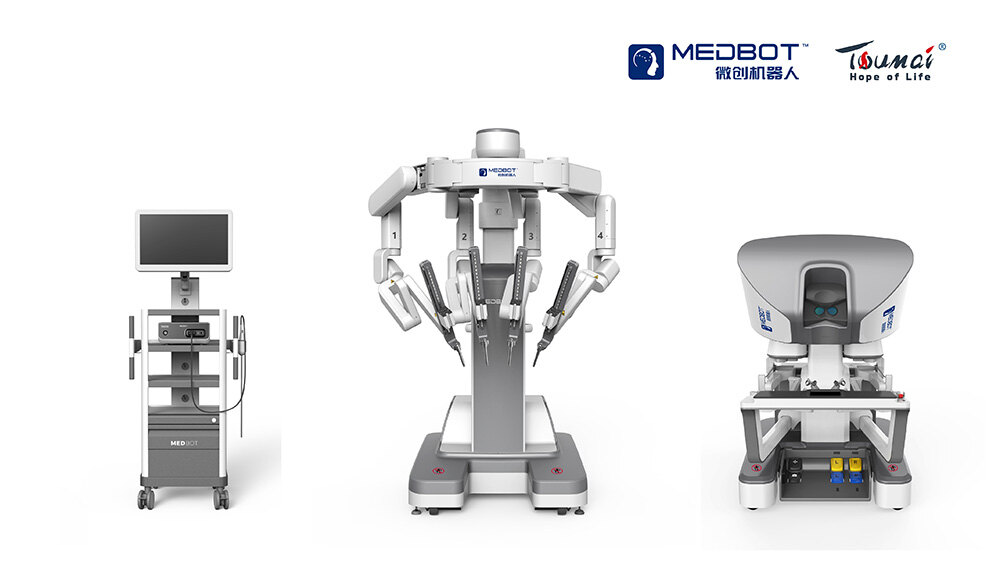
Saba Darmon clinic has the MedBot Toumai robotic system, and a hemicolectomy can be performed with robotic assistance — the surgeon chooses the method after assessment. For colon cancer, laparoscopic surgery is the well-studied standard.
| Method | When it suits | Key feature |
|---|---|---|
| Laparoscopic | Most colon tumours | Small ports, less pain, quick recovery; cancer outcomes comparable to open surgery |
| Robotic | Delicate work near major vessels, an anastomosis inside the abdomen, obesity, complex anatomy | Magnified 3D view, articulated instruments; the operation may take longer; its advantages are still being studied |
| Open | A large tumour or one growing into nearby organs, emergency obstruction, dense adhesions | Large incision, longer recovery; sometimes the safest choice |
To be plain: in a routine case, laparoscopic hemicolectomy gives results no worse than the robotic approach; the robot’s benefit shows mainly in complex situations. The general difference between the two approaches is explained in a separate article. In any minimally invasive operation there remains a chance of switching to open surgery if safety requires it.
Will I need a stoma?
In colon operations the ends of the bowel are joined straight away in most patients, and a stoma (an opening of the bowel onto the abdominal wall) is usually not needed. Sometimes — for example with a bowel obstruction, severe inflammation or a high risk to the join — a temporary stoma is made and closed later in a separate operation. It is useful to discuss this possibility with your surgeon in advance.
Enhanced recovery after surgery (ERAS)
- no prolonged fasting before surgery, often with a special carbohydrate drink;
- a pain-relief plan that avoids strong opioids where possible;
- getting up and walking on the day of surgery or the next day, with early fluids and light food;
- prevention of blood clots and breathing exercises;
- a hospital stay of usually a few days; you go home once the bowel is working and you are eating well.
At home, heavy lifting is restricted for several weeks, while walking every day is encouraged.
Chemotherapy and follow-up after surgery
Once the histology result is ready, the oncology board decides on further treatment: in early stages observation alone is often enough, while if lymph nodes are affected or there are risk factors, adjuvant chemotherapy is recommended. Regular follow-up continues over the following years: medical reviews, CEA blood tests, CT scans and colonoscopy at set intervals. All areas of robotic surgery are listed on this page.
Frequently asked questions
How long does surgery for colon cancer take?
Usually a few hours; the time depends on the tumour location, adhesions, the patient’s build and the method chosen. A robotic operation may take a little longer than a laparoscopic one.
Does the bowel work normally after a hemicolectomy?
For most people, yes. In the first weeks bowel movements may be more frequent or looser, and the bowel then usually adapts. Your doctor will give advice on diet.
Is a robotic hemicolectomy better than a laparoscopic one?
Not always. In a routine case the results are similar, and laparoscopy is the standard. The robot may be more convenient with complex anatomy or obesity; the surgeon chooses the method after assessment.
Is chemotherapy always needed after colon cancer surgery?
No. In early stages observation alone is often enough. Whether chemotherapy is needed is decided by the oncology board based on the histology result.
Can bowel cancer be detected early?
Yes, and the best way to do so is regular colonoscopy. It finds cancer at an early stage and allows polyps to be removed before they turn into cancer.
How long is the hospital stay after a hemicolectomy?
With an enhanced recovery programme, usually a few days. You go home once the bowel is working and you are eating well. Recovery at home is covered in this article.
Is colon cancer hereditary?
Most cases are not inherited, but the risk is higher if close relatives have had the disease. In such families screening starts earlier, and genetic counselling is sometimes recommended.
More about robotic surgery:
- Robotic Surgery in Tashkent — all directions
- Robotic Surgery in Tashkent: the MedBot Toumai System
- Is Robotic Surgery Safe? 10 Questions
- Robotic Surgery vs Laparoscopy: What Is the Difference
- Preparing for Robotic Surgery: Step by Step
- Recovery After Robotic Surgery
- Bladder Cancer: Robotic Cystectomy
- Hernia: Robotic Repair
- Gallbladder: Robotic Cholecystectomy
- Who Is Not Suitable for Robotic Surgery
- Uterine and Cervical Cancer: Robotic Surgery
- Large Prostate Adenoma: TURP or Robotic Surgery
- Varicocele Surgery: Marmar or Robotic
- Kidney Removal: Robotic Nephrectomy
- Ectopic Pregnancy: Tube-Sparing Robotic Surgery
- Female Urinary Incontinence: TVT or Robotic Surgery
- Uterus Removal: Robotic Hysterectomy
- Hiatal Hernia and Reflux: Robotic Fundoplication
- Liver Tumour: Robotic Liver Resection
- Pancreatic Tumour: Robotic Resection
- Obesity Surgery: Robotic Sleeve Gastrectomy
- Diastasis Recti: Robotic Repair
- Anaesthesia and Pain Control in Robotic Surgery
- Pregnancy After Robotic Myomectomy
- Robotic Prostatectomy
- Kidney Tumour: Robotic Partial Nephrectomy
- Colorectal Cancer: Robotic Surgery
- Uterine Fibroids: Robotic Surgery
- Endometriosis and Ovarian Cysts: Robotic Surgery
- What Is Telesurgery?
- Robotic Surgery in Older Adults
- Stomach Cancer: Robotic Gastrectomy
- Hydronephrosis: Robotic Pyeloplasty
- Pelvic Organ Prolapse: Robotic Sacrocolpopexy
- Adrenal Tumour: Robotic Adrenalectomy
Doctors for consultation
Consultations and surgery on the large bowel are carried out by our surgeons. Our doctors in this field:




Book a consultation with a surgeon
Which operation and approach suit a colon tumour, the doctor will explain every option after assessment.
Call now — +998 71 210-30-30Contacts
Address: 7A/3 Nurafshon street, Tashkent
Phone: +998 71 210-30-30 · WhatsApp: +998 95 662-30-30
Opening hours: Monday–Saturday, 09:00–18:00
E-mail: