


Useful articles

Robotic Hysterectomy: Uterus Removal — When It Is Needed and Life After
Doctor's blog
sbdrmn
Direction: Robotic surgery · All services
Talk of removing the uterus (hysterectomy) worries many women: "will menopause start?", "will my life change?", "is there no other way?". Each of these questions has a clear answer. Below, in plain language: when the operation is truly needed, when the uterus can be kept, what happens to the ovaries, how robotic, laparoscopic, vaginal and open approaches differ, and what life looks like after surgery.
Contents
- What a hysterectomy is and when it is needed
- Can the uterus be kept? What is considered first
- Total or subtotal hysterectomy: is the cervix removed?
- Are the ovaries kept, and what does it mean for menopause?
- Robotic, laparoscopic, vaginal or open: an honest comparison
- How the operation goes and how long recovery takes
- Life and sex after a hysterectomy
- What to agree with your doctor
- Frequently asked questions
What a hysterectomy is and when it is needed
A hysterectomy is an operation to remove the uterus (womb). It is one of the most serious decisions in gynaecology, because it permanently ends the possibility of pregnancy. That is why a doctor first looks at ways to keep the uterus and suggests a hysterectomy only when these have not helped or are not safe. For benign (non-cancerous) conditions the main reasons are:
- large or multiple fibroids — when the nodes cannot be removed while keeping the uterus, or the woman does not plan further children; fibroids are covered in detail in a separate article;
- adenomyosis — the lining grows into the wall of the uterus, causing painful, heavy periods that medication does not control;
- heavy bleeding that does not respond to treatment — leading to anaemia after hormonal and other methods have failed;
- precancerous changes — for example atypical endometrial hyperplasia, especially when pregnancy is no longer planned.
In cancer of the uterus or cervix the extent of surgery is different (lymph nodes, surrounding tissue) and it is planned together with an oncologist — this is covered in a separate article. This article is about benign conditions.
Can the uterus be kept? What is considered first
A hysterectomy should be the last step, not the first. Depending on the situation, the following are discussed:
- myomectomy — removing only the fibroids and keeping the uterus, especially if pregnancy is planned;
- hormonal treatment and a hormone-releasing intrauterine device — for heavy bleeding and adenomyosis;
- hysteroscopy — removing a polyp or a small submucosal fibroid from inside the uterus without incisions;
- endometrial ablation — in selected cases, to reduce bleeding.
If you are planning to have children, tell your doctor at the very first consultation — the whole approach depends on it.
Total or subtotal hysterectomy: is the cervix removed?
| Type | What is removed | Comment |
|---|---|---|
| Total | The body of the uterus and the cervix | The most common option; your doctor will say whether further screening is needed |
| Subtotal (supracervical) | Only the body of the uterus; the cervix stays | Chosen in some cases; because the cervix remains, regular smear tests continue |
| Tubes and ovaries | Decided separately | Explained below — the key question for menopause |
Are the ovaries kept, and what does it mean for menopause?
Many women fear that "once the uterus is removed, menopause starts straight away". In fact the sex hormones are made not by the uterus but by the ovaries. If the ovaries are kept, periods stop, but hormone production usually continues until the natural age of menopause; some observations suggest menopause may arrive slightly earlier.
If both ovaries are removed (for example, because they are also affected or the inherited risk is high), menopause begins immediately — hot flushes, poor sleep and vaginal dryness may appear. In that case hormone replacement therapy or other support is discussed with the doctor. The fallopian tubes are often removed: this does not affect ovarian hormones. The decision is made together, taking into account age, the state of the ovaries and family history.
Robotic, laparoscopic, vaginal or open: an honest comparison
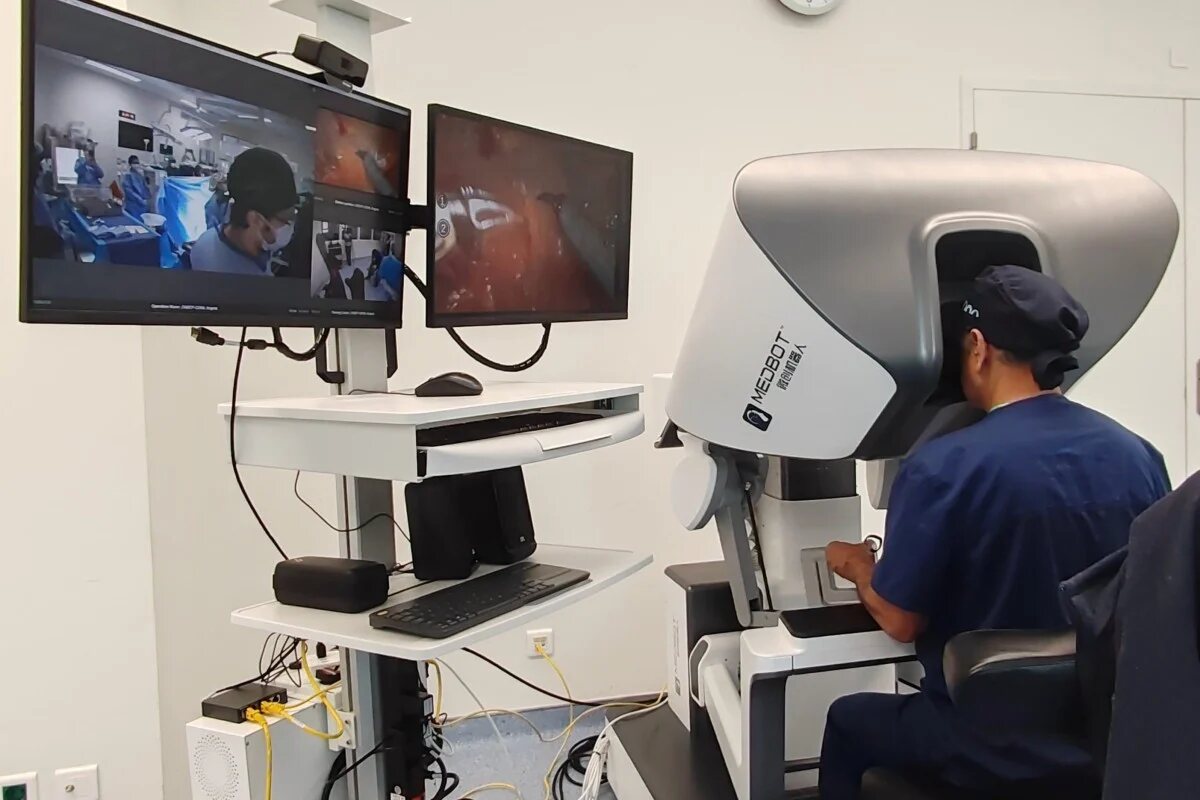
Saba Darmon clinic has the MedBot Toumai robotic system, and a hysterectomy can be performed with robotic assistance. But the robot is not the only right path: the surgeon chooses the method after assessment, based on the size of the uterus, previous operations, adhesions and general health.
| Method | When it suits | Key feature |
|---|---|---|
| Vaginal | Uterus not large, some prolapse, few previous abdominal operations | No abdominal incisions; when suitable, one of the gentlest routes |
| Laparoscopic | Most benign cases | Through small ports, less pain, quick recovery; performed at the clinic |
| Robotic | Large uterus, endometriosis or adhesions, obesity, a narrow pelvis | Magnified 3D view, articulated instruments; precise work near the ureters and blood vessels |
| Open | Very large uterus, dense adhesions, some emergencies | Large incision, longer recovery; sometimes the safest choice |
To be plain: in a straightforward case, laparoscopic hysterectomy or vaginal hysterectomy gives results no worse than the robotic approach. The robot’s advantage lies in difficult anatomy. The difference between the two is explained in this article. In any minimally invasive operation there is a chance of switching to open surgery (conversion) if safety requires it — this is worth knowing in advance.
How the operation goes and how long recovery takes
- beforehand: blood tests, ultrasound, MRI if needed, a cervical smear and assessment of the endometrium, a review by the anaesthetist;
- general anaesthesia; several small ports in the abdomen; the uterus is freed and usually removed through the vagina;
- the removed tissue is sent for histology — the result guides further follow-up;
- walking is usually possible the next day, with a few days in hospital;
- most people return to desk work after 2–3 weeks; heavy lifting and sport are restricted for about 6 weeks.
General recovery advice is collected in a separate article.
If after surgery you have heavy bleeding, a temperature above 38 °C, increasing abdominal pain, difficulty passing urine or swelling of one leg, contact a doctor at once; if you feel seriously unwell, call 103.
Life and sex after a hysterectomy
To let the stitches at the top of the vagina heal, intercourse is usually postponed for 6–8 weeks, until the doctor says it is safe. After that most women notice no significant change, and for some, quality of life actually improves once pain and bleeding are gone. If the ovaries were removed, dryness may occur, and there are good ways to manage it. Periods stop and pregnancy is no longer possible. The emotional side matters too: some women experience a sense of loss, and talking about it openly with the doctor is entirely normal.
What to agree with your doctor
Whether the uterus can be kept; total or subtotal surgery; what happens to the tubes and ovaries; which method and why; the likelihood of conversion; when histology will be ready; return to work and follow-up visits. All areas of robotic surgery are listed on this page.
Frequently asked questions
Does menopause start after a hysterectomy?
Not straight away if the ovaries are kept: periods stop, but the ovaries go on producing hormones. If both ovaries are removed, menopausal symptoms appear quickly and treatment is discussed with the doctor.
Is robotic hysterectomy better than laparoscopic?
Not always. In a straightforward case the results are similar; the robot is more convenient with a large uterus, adhesions or a narrow pelvis. The surgeon chooses the method after assessment.
How soon can I go back to work after a hysterectomy?
Most people return to desk work after 2–3 weeks and to heavy physical work after about 6 weeks. Your doctor will give the exact time based on the extent of surgery and your recovery.
Does endometrial hyperplasia always mean removing the uterus?
No. Simple hyperplasia is usually controlled with hormonal treatment; with atypical hyperplasia a hysterectomy is discussed more often. More details are in the article on polyps and hyperplasia.
Does a prolapsed uterus have to be removed?
Not necessarily: in many cases there are operations that secure the uterus in place, such as robotic sacrocolpopexy. The choice depends on the degree of prolapse, age and general health.
Will I gain weight after a hysterectomy?
The operation itself does not directly affect weight. Weight gain is more often linked to inactivity during recovery and diet; a gradual return to activity helps.
How long does the operation take?
Usually a few hours; the time depends on the size of the uterus, adhesions and the method chosen.
More about robotic surgery:
- Robotic Surgery in Tashkent — all directions
- Robotic Surgery in Tashkent: the MedBot Toumai System
- Is Robotic Surgery Safe? 10 Questions
- Robotic Surgery vs Laparoscopy: What Is the Difference
- Preparing for Robotic Surgery: Step by Step
- Recovery After Robotic Surgery
- Bladder Cancer: Robotic Cystectomy
- Hernia: Robotic Repair
- Gallbladder: Robotic Cholecystectomy
- Who Is Not Suitable for Robotic Surgery
- Uterine and Cervical Cancer: Robotic Surgery
- Large Prostate Adenoma: TURP or Robotic Surgery
- Varicocele Surgery: Marmar or Robotic
- Kidney Removal: Robotic Nephrectomy
- Ectopic Pregnancy: Tube-Sparing Robotic Surgery
- Female Urinary Incontinence: TVT or Robotic Surgery
- Hiatal Hernia and Reflux: Robotic Fundoplication
- Liver Tumour: Robotic Liver Resection
- Pancreatic Tumour: Robotic Resection
- Obesity Surgery: Robotic Sleeve Gastrectomy
- Diastasis Recti: Robotic Repair
- Colon Cancer: Robotic Hemicolectomy
- Anaesthesia and Pain Control in Robotic Surgery
- Pregnancy After Robotic Myomectomy
- Robotic Prostatectomy
- Kidney Tumour: Robotic Partial Nephrectomy
- Colorectal Cancer: Robotic Surgery
- Uterine Fibroids: Robotic Surgery
- Endometriosis and Ovarian Cysts: Robotic Surgery
- What Is Telesurgery?
- Robotic Surgery in Older Adults
- Stomach Cancer: Robotic Gastrectomy
- Hydronephrosis: Robotic Pyeloplasty
- Pelvic Organ Prolapse: Robotic Sacrocolpopexy
- Adrenal Tumour: Robotic Adrenalectomy
Doctors for consultation
Hysterectomy and uterus-sparing operations are performed by our gynaecological surgeons. Our doctors in this field:






Book an appointment with a gynaecologist
Whether a hysterectomy is needed or the uterus can be kept, the doctor will explain every option after assessment.
Call now — +998 71 210-30-30Contacts
Address: 7A/3 Nurafshon street, Tashkent
Phone: +998 71 210-30-30 · WhatsApp: +998 95 662-30-30
Opening hours: Monday–Saturday, 09:00–18:00
E-mail: