


Useful articles

Spermatocele and Epididymal Cyst: Is It Dangerous and When Surgery Is Needed
Doctor's blog
sbdrmn
Direction: Robotic surgery · All services
A spermatocele, also called an epididymal cyst, is a benign, fluid-filled sac that forms in the epididymis, the coiled tube behind the testicle. It is usually painless, can be felt separately from the testicle and is often found by chance — during self-examination or on an ultrasound scan. Below we explain what it is, how to tell it apart from a hydrocele, varicocele, hernia or testicular tumour, when to seek urgent help, how it is diagnosed, when watchful waiting is enough, when surgery is needed and how surgery may affect fertility.
Contents
- What a spermatocele is and how it differs from an epididymal cyst
- Why an epididymal cyst develops
- Spermatocele symptoms: what the lump feels like
- A lump in the scrotum: telling a spermatocele apart from other conditions
- When to seek urgent help
- Diagnosis: examination, transillumination and scrotal ultrasound
- Is a spermatocele dangerous, and when is surgery needed?
- Fertility and surgery: what younger men should know
- Recovery after surgery and monthly self-examination
- Questions to ask your urologist — assessment at Saba Darmon
- Frequently asked questions
What a spermatocele is and how it differs from an epididymal cyst
A spermatocele is a benign, fluid-filled cyst in the epididymis. The epididymis is a very long, thin, tightly coiled tube that sits along the back and top of each testicle. Sperm made in the testicle mature and are stored here before ejaculation. When part of this tube widens and fluid collects inside it, a small sac forms.
Doctors use two terms. If the fluid in the cyst contains sperm, it is called a spermatocele; if the fluid is clear and contains no sperm, it is called an epididymal cyst. In practice the two look the same, are investigated in the same way and are treated in the same way, so for the patient the distinction makes almost no difference. These cysts are very common. Many cause no symptoms at all and are found by chance on a scrotal ultrasound scan done for another reason.
Why an epididymal cyst develops
In most cases no exact cause can be found. The cyst is thought to form when one of the tiny channels of the epididymis becomes partly blocked, so fluid cannot drain and builds up. Previous inflammation of the epididymis (epididymitis), an injury to the scrotum or earlier surgery in the area may also play a part. These cysts are most common in middle-aged men but can appear in teenagers too; in adolescents small cysts sometimes shrink on their own. The key point is reassuring: a spermatocele is not cancer, does not turn into cancer and is not sexually transmitted.
Spermatocele symptoms: what the lump feels like
Most often a man notices a small, smooth, round lump in the scrotum, above or behind the testicle, while washing or examining himself. Typical features include:
- the lump can be felt separately from the testicle — you can tell the two apart with your fingers;
- it is soft or slightly firm and rubbery, with a smooth surface, and is usually painless;
- it stays the same size for a long time or grows very slowly;
- a large cyst may cause a feeling of heaviness, dragging or discomfort in the scrotum, especially after standing for a long time or after physical work;
- sometimes there are several cysts on one side, or cysts on both sides.
A spermatocele does not usually affect passing urine, erections or sex life. If you have constant or severe pain in the scrotum, do not simply put it down to the cyst — other causes need to be ruled out.
A lump in the scrotum: telling a spermatocele apart from other conditions
Any new lump in the scrotum should be checked by a doctor. Conditions that look similar from the outside range from harmless ones to those that need prompt investigation:
| Condition | Where it is felt | Typical features | How urgent |
|---|---|---|---|
| Spermatocele or epididymal cyst | Above or behind the testicle, separate from it | Smooth, soft, painless; light shines through it | Routine appointment |
| Hydrocele | Surrounds the whole testicle | The scrotum is evenly enlarged, the testicle cannot be felt separately; light shines through it | Routine appointment |
| Varicocele | Above the testicle, usually on the left | Soft veins like a “bag of worms”; larger when standing, smaller when lying down | Routine appointment |
| Inguinal hernia | Comes down from the groin into the scrotum | Bulges when you cough; may go back in when you lie down | Routine; urgent if painful and it will not go back |
| Testicular tumour | Within the testicle itself | Hard, often painless; light does not shine through it | See a urologist without delay, within days |
A simple rule: a lump that is separate from the testicle, smooth and soft is most often a cyst; a hard lump within the testicle itself means you should see a urologist without waiting. There are separate articles on similar conditions: hydrocele, varicocele and inguinal hernia.
When to seek urgent help
A spermatocele on its own is not an emergency. However, some symptoms in the scrotum can point to a different and much more serious problem, and these should never be watched at home.
Sudden severe pain in a testicle, especially with nausea, vomiting or the testicle pulling up higher than usual, may be testicular torsion. Hours matter: call 103 immediately or go to an emergency department. If you notice a hard lump within the testicle, a lump that is growing quickly, or redness, swelling of the scrotum and fever, see a urologist without delay.
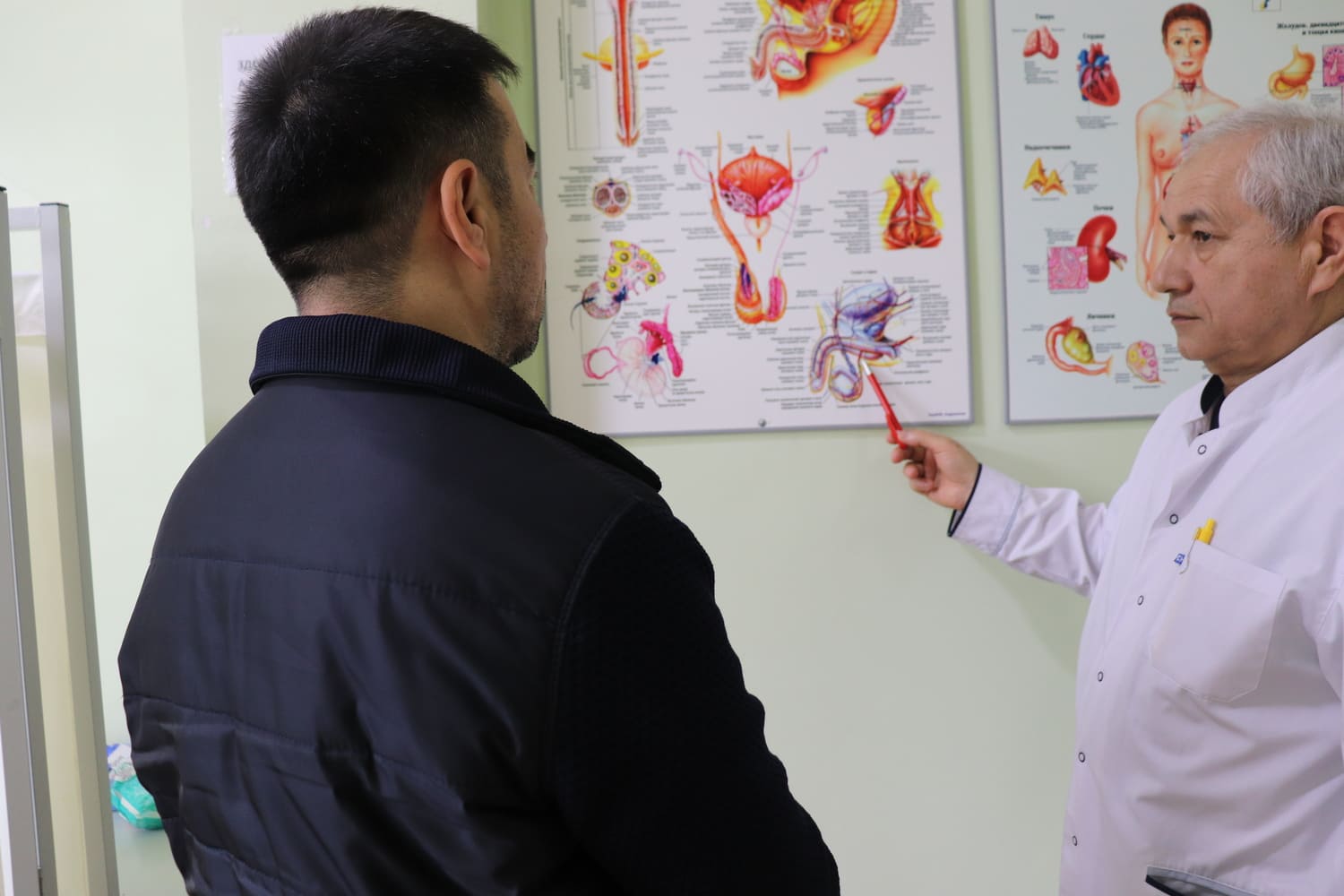
Diagnosis: examination, transillumination and scrotal ultrasound
Diagnosis is usually simple and painless. The urologist first asks about your symptoms: when you noticed the lump, whether it has grown, whether it hurts and whether you have had any injury or infection. They then examine the scrotum with you standing and lying down, and check that the lump is separate from the testicle.
Transillumination means shining a light through the scrotum in a darkened room: a fluid-filled cyst lets the light through and glows, while solid tissue does not. It is a quick, simple test, but the main investigation that confirms the diagnosis is a scrotal ultrasound scan. Ultrasound shows exactly where the cyst is, how big it is and whether its fluid is clear — and, most importantly, confirms that the testicle itself is healthy. If needed, blood flow is assessed using Doppler mode. In unclear cases the doctor may arrange further tests.
Is a spermatocele dangerous, and when is surgery needed?
For most men the answer is reassuring: a spermatocele is benign, does not become cancerous and does not usually cause infertility on its own. A small, painless cyst needs no treatment — simply keeping an eye on it is enough. There is no medicine that shrinks these cysts, so creams or tablets advertised to “dissolve” them are of no use. Treatment is considered only when the cyst becomes a problem: when it is large and causes heaviness or discomfort, leads to persistent pain or interferes with everyday life.
| Option | How it is done | What to know |
|---|---|---|
| Watchful waiting | No treatment; monthly self-examination and, if needed, a follow-up scan | The main approach for small, painless cysts |
| Spermatocelectomy (removal of the cyst) | Under anaesthetic, the cyst is freed from the epididymis and removed through a small cut in the scrotum | The most reliable option; risks include swelling, a collection of blood (haematoma), infection, long-term pain and recurrence; damage to the tubes of the epididymis can block the passage of sperm on that side |
| Aspiration and sclerotherapy | The fluid is drawn off with a needle; sometimes a substance is injected to make the walls of the cyst stick together | The cyst often refills; sclerotherapy can cause inflammation and damage to the epididymis, so it is not usually recommended for men who want children |
You can read about the tests usually needed before an operation in our article on pre-operative tests. Sometimes there is more than one problem in the scrotum at the same time — for example, a cyst together with a varicocele. In that case each is assessed on its own merits (see varicocele surgery options).
Fertility and surgery: what younger men should know
The epididymis is the pathway that sperm travel along. Because the wall of the cyst lies very close to the tubes of the epididymis, removing it can injure these tubes or lead to scarring that blocks them later. As a result, the passage of sperm from that side may be affected. If the other testicle and epididymis are healthy, this does not usually take away the ability to father children, but it is a risk you should know about in advance.
For this reason, younger men who are planning a family are usually advised to delay surgery and keep the cyst under observation unless it is causing real discomfort. If an operation is still necessary, talk to your urologist about your plans for children beforehand — sometimes it is helpful to have a semen analysis before surgery.
Recovery after surgery and monthly self-examination
Most men go home on the day of a spermatocelectomy or the following day. Swelling and bruising of the scrotum in the first few days are normal; firm, supportive underwear, cold packs and the pain relief your doctor prescribes all help. Your surgeon will tell you when you can return to lifting, sport and sex. The swelling settles gradually over several weeks. If you develop a fever, increasing pain or a sudden marked enlargement of the scrotum, come back for review sooner than planned.
Whether or not you have had surgery, it is worth examining your testicles once a month. After a warm shower, gently roll each testicle between your fingers and thumb, checking its shape, size and any new hard areas. The epididymis can be felt behind the testicle as a soft, cord-like structure — this is normal. If you notice a new lump, a hard area or any other change, see a urologist.
Questions to ask your urologist — assessment at Saba Darmon
Before your appointment, it helps to write down your questions: Is this definitely a cyst, or could it be something else? Does the ultrasound show that the testicle itself is healthy? Can the cyst simply be watched, and when should I come back? Do I need an operation, and how might it affect my chances of having children? What are the alternatives to surgery? At Saba Darmon clinic, our urologists carry out the examination, and scrotal ultrasound and the necessary laboratory tests are available on site. Based on the findings, the doctor will discuss the treatment options and next steps with you. You can find more information on the page of our urology department.
Frequently asked questions
Can a spermatocele go away on its own?
In adult men a spermatocele does not usually disappear by itself, but it often stays much the same size for years. In teenagers, small epididymal cysts sometimes shrink without treatment. There is no tablet or cream that dissolves the cyst. So if the cyst is small and painless, the sensible approach is to examine yourself once a month and see a urologist again if it grows, starts to hurt or changes shape.
Can a spermatocele turn into cancer?
No. Spermatoceles and epididymal cysts are benign and do not turn into cancer. However, any new lump in the scrotum should still be checked by a doctor, because a testicular tumour can also be painless. The main difference is that a tumour is felt as a hard lump within the testicle itself, whereas a cyst is soft and separate from the testicle. A scrotal ultrasound scan reliably tells the two apart.
Does a spermatocele cause infertility?
The cyst itself does not usually cause infertility. The main risk comes from surgery: when the cyst is removed, the tubes of the epididymis can be damaged, which may block the passage of sperm on that side. That is why younger men planning a family are usually advised to delay surgery unless the cyst causes real discomfort. If fertility is a concern, a semen analysis and checks for other causes, such as varicocele, are needed.
Can a spermatocele come back after surgery?
Complete removal of the cyst is the most reliable treatment, but a cyst can occasionally recur or a new one can form. After simple needle aspiration the cyst usually fills up again, which is why this approach is used less often. After surgery, carry on with monthly self-examination, and see a urologist if you notice any new change in the scrotum; they will decide whether a follow-up scan is needed.
Can I play sport and have sex with a spermatocele?
Yes. A small, painless cyst usually needs no restrictions at all: sport, physical work and sex can continue as normal. If a larger cyst causes heaviness, firm supportive underwear can make exercise more comfortable. If you develop severe pain or swelling after a blow to the scrotum, see a doctor. Your surgeon will explain any temporary restrictions separately if you have an operation.
Related reading:
Doctors for consultation
Spermatoceles and epididymal cysts are assessed by our urologists using examination and scrotal ultrasound, and the treatment plan is discussed together with the patient. Our doctors in this field:

Book an appointment with a urologist
Found a lump in your scrotum? A urologist’s examination and a scrotal ultrasound scan will show what it is and whether it needs simple monitoring or treatment.
Call now — +998 71 210-30-30Contacts
Address: 7A/3 Nurafshon street, Tashkent
Phone: +998 71 210-30-30 · WhatsApp: +998 95 662-30-30
Opening hours: Monday–Saturday, 09:00–18:00
E-mail: