


Useful articles

Incisional Hernia After Surgery: Signs, Risks and Mesh Repair Options
Doctor's blog
sbdrmn
Direction: Robotic surgery · All services
An incisional hernia is a bulge that appears at the site of an old incision after abdominal surgery. It is not rare among people who have had an operation on the abdomen, and it usually grows larger over time. Below we explain in plain language why this kind of hernia forms, which symptoms should worry you, why a support belt does not help, and how open or laparoscopic mesh repair is carried out.
Contents
- What an incisional hernia is and why it develops
- Signs of an incisional hernia
- Why a support belt does not cure a hernia
- Diagnosis: measuring the hernia and its gate
- Incisional hernia surgery: open or laparoscopic
- Preparing for the operation
- Recovery after hernia repair and lifting limits
- How to prevent recurrence
- Frequently asked questions
What an incisional hernia is and why it develops
Any incision in the abdominal wall heals after it is closed, but scar tissue is weaker than healthy fascia. If the muscle and fascia layer does not knit together fully, a defect — the "hernia gate" — remains, and under pressure from inside the abdomen fat or loops of bowel start to push through it. This is an incisional (post-operative ventral) hernia. It most often forms in the first one to two years after surgery, but it can appear much later as well.
Factors that raise the risk include:
- wound infection — an incision that became infected or healed slowly leaves a weak scar;
- excess weight and obesity — pressure inside the abdomen is constantly high and the tissues are stretched;
- smoking — it impairs blood supply and collagen formation;
- chronic cough (bronchitis, asthma, smoker's cough), constipation, straining to pass urine;
- lifting heavy weights too early — in the weeks when the scar has not yet gained strength;
- diabetes, anaemia, protein deficiency, long-term steroid treatment;
- a large midline incision, emergency surgery, repeated previous operations.
Signs of an incisional hernia
The most typical sign is a bulge in or next to the scar. It gets bigger when you stand, cough or strain, and becomes smaller or disappears completely when you lie down. Many people feel a dragging ache, heaviness or discomfort after physical work. With large hernias, constipation, bloating and thinning or redness of the overlying skin may be added. A hernia does not go away on its own — on the contrary, it usually grows slowly and its gate widens over time.
A strangulated hernia is an emergency. If the bulge suddenly becomes painful and hard, no longer goes back when you lie down, and you develop nausea, vomiting, or cannot pass wind or stool — do not wait and do not try to push it back yourself. Call an ambulance immediately — 103. Trapped bowel can be seriously damaged within a few hours.
Why a support belt does not cure a hernia
An abdominal binder holds the hernia in from the outside and can give temporary relief to some patients — for example, those waiting for surgery, or those who cannot be operated on for now because of serious other illnesses. But it does not close the defect in the fascia: the gate stays open and keeps widening. Wearing a binder for a long time weakens the abdominal muscles and does not remove the risk of strangulation. The only way to get rid of an incisional hernia completely is a surgical repair; its timing is decided by the surgeon after examination.
Diagnosis: measuring the hernia and its gate
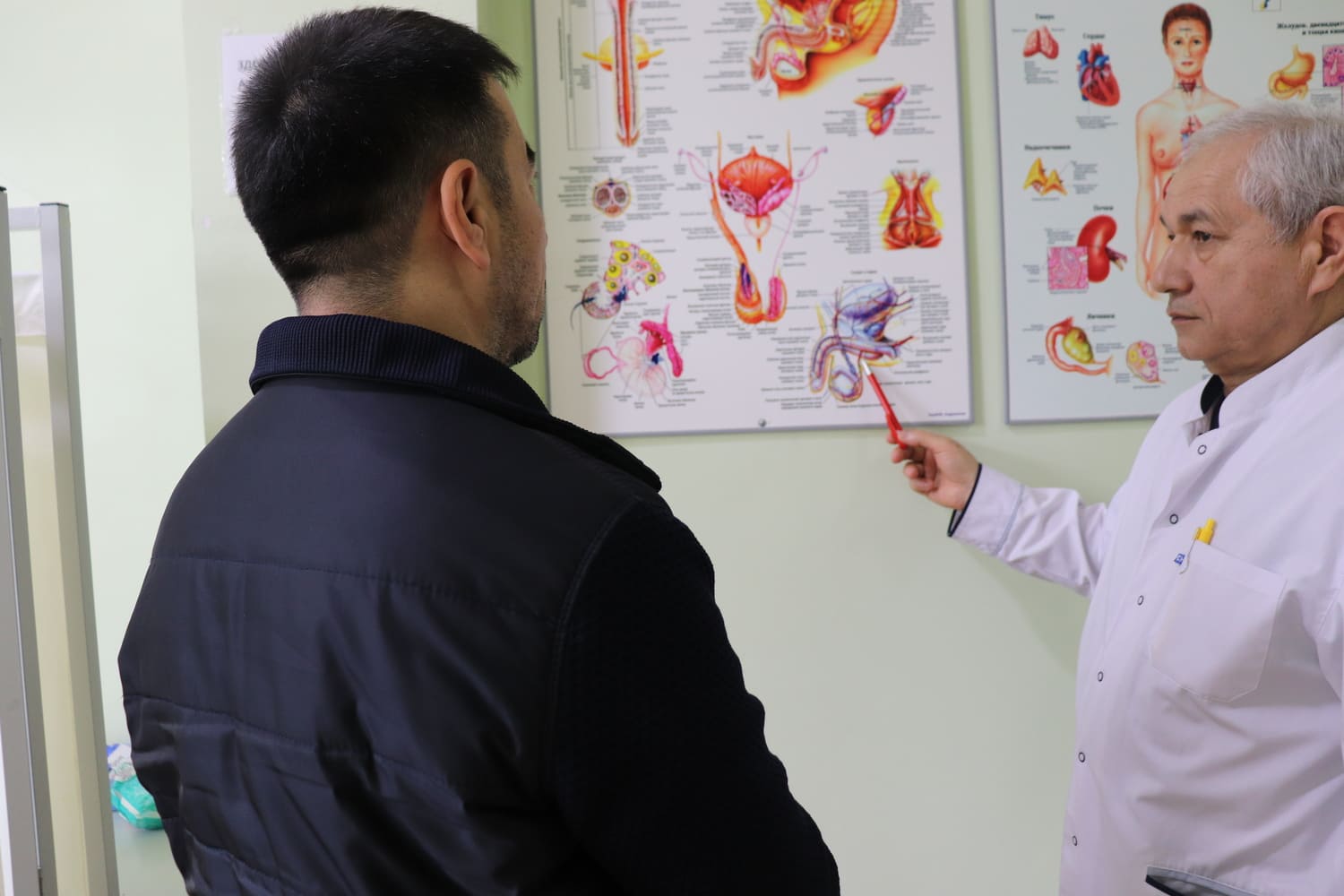
The surgeon examines the abdomen standing and lying, and checks the cough impulse. Then an ultrasound of the abdominal wall is done — it shows the size of the defect, what is inside the hernia sac, and sometimes additional defects that cannot be felt. For large, recurrent or complex hernias a CT scan is ordered: it measures the width of the gate precisely, shows the state of the abdominal wall muscles and the volume of the hernia relative to the abdominal cavity — the operation plan is built on this. You can read more in the CT scan article.
Incisional hernia surgery: open or laparoscopic
Today the standard is not simply to stitch the defect closed but to reinforce it with a mesh. Large hernias repaired with stitches alone often come back, while a mesh gives the abdominal wall an extra framework and becomes incorporated into the tissue over time. There are two main approaches:
| Point | Open repair | Laparoscopic repair (for example, IPOM) |
|---|---|---|
| Access | An incision along the old scar; excess skin and scar can be removed | Three small punctures; camera and instruments work from inside |
| Where the mesh goes | Between the muscle layers or on top of them | From inside, overlapping the defect widely; a mesh with a special protective coating |
| Who it suits more often | Very large hernias, overhanging skin, when the abdominal wall needs reconstruction | Small and medium hernias, several defects, patients with obesity |
| Recovery | Usually longer; a drain is more often needed | Usually quicker; less wound pain and a lower risk of wound infection |
IPOM means placing the mesh from inside the abdominal cavity, over the defect. The side of the mesh facing the bowel has a special coating so that it does not stick to it. If the defect is large, its edges are first stitched together and then the mesh is laid over them. You can read more in our articles on laparoscopic hernia repair and open hernia surgery. In selected cases a robot-assisted repair may also be considered — see robotic hernia repair; the surgeon always chooses the method after assessment.
Preparing for the operation
With an incisional hernia, preparation is half of the result. The surgeon will usually ask you to:
- lose weight — especially with obesity; even a few kilograms lower the risk of recurrence (if needed, with weight management by an endocrinologist);
- stop smoking — at least several weeks before and after the operation;
- control blood sugar — with diabetes, glucose is brought to target levels first;
- treat cough, constipation and urinary problems in advance;
- complete the standard tests and specialist reviews — see the pre-operative tests checklist.
Recovery after hernia repair and lifting limits
After laparoscopic repair most patients stay in hospital for one to three days; after open repair the stay is usually longer. Walking is encouraged from the first day: it helps prevent blood clots and chest complications. Pain is usually controlled with tablets — there is a separate article on pain after surgery and fast recovery. The doctor often recommends wearing an abdominal binder for several weeks — now not as treatment, but to support the healing scar.
A rough guide to lifting: no heavy objects in the first month (the limit is often around 5 kg), then a gradual increase in load over one to three months; heavy manual work and strength sports only once the surgeon allows them. The exact timing depends on the size of the hernia and the type of operation.
How to prevent recurrence
Mesh repair markedly lowers the risk of recurrence, but not to zero. The same factors increase it again: obesity, smoking, coughing, constipation, poorly controlled diabetes and lifting too early. Keeping your weight stable, not smoking, avoiding straining and coming to follow-up visits are the most reliable ways to keep the result.
If you notice a new bulge, pain or discomfort near the scar, do not put off seeing a surgeon. A small hernia found early is easier and safer to repair than a large one that has been left for years.
Frequently asked questions
Is an incisional hernia dangerous?
Yes, the main danger is strangulation: bowel or fat gets trapped in the gate and its blood supply is cut off. If you have sudden pain, vomiting and the bulge will not go back in, call 103 immediately.
Can an incisional hernia go away on its own?
No. The defect in the fascia does not close by itself, and the hernia usually grows over time. Only a surgical repair can fix it.
Can I just wear a hernia belt?
A binder gives temporary relief but does not cure the hernia or remove the risk of strangulation. It is meant for the waiting period before surgery or for people who cannot have an operation.
Which is better, open or laparoscopic repair?
There is no single answer: it depends on the size of the hernia, the number of defects, the condition of the skin and your general health. The surgeon chooses the method based on ultrasound or CT findings.
Does the mesh stay in the body, and is it harmful?
Yes, the mesh stays permanently, becomes incorporated into the tissue and strengthens the abdominal wall. Modern meshes have been widely used for many years; those placed from inside have a special coating so they do not stick to the bowel.
When can I go back to work after the operation?
After laparoscopic repair, desk work is often possible within one to two weeks; after open repair it is usually later. Heavy physical work is resumed only with the surgeon’s permission, typically after several months.
Can the hernia come back?
Mesh repair markedly lowers the risk of recurrence but does not remove it completely. Controlling your weight, not smoking and avoiding early heavy lifting are the best protection.
Related reading:
Doctors for consultation
Incisional hernias are repaired by our surgeons using open and laparoscopic techniques. Our doctors in this field:




Book a consultation with a surgeon
Noticed a bulge near your scar? An examination and ultrasound will show the size of the hernia and which repair suits you.
Call now — +998 71 210-30-30Contacts
Address: 7A/3 Nurafshon street, Tashkent
Phone: +998 71 210-30-30 · WhatsApp: +998 95 662-30-30
Opening hours: Monday–Saturday, 09:00–18:00
E-mail: