


Useful articles

Perforated Eardrum: Causes, Symptoms, What to Do and When Tympanoplasty Is Needed
Doctor's blog
sbdrmn
Direction: Robotic surgery · All services
A perforated eardrum is a hole in the tympanic membrane caused by an ear infection, cleaning the ear with a cotton bud or a sudden change in pressure. It shows itself through pain, discharge from the ear and reduced hearing. Below: the causes and symptoms, what to do and avoid in the first days, when the hole heals by itself and when tympanoplasty is needed.
Contents
What the eardrum is and how it gets perforated
The eardrum (tympanic membrane) is a paper-thin membrane that separates the outer ear canal from the middle ear. It vibrates with sound waves and passes these vibrations on to the tiny hearing bones. Because it is so thin, it can tear as a result of pressure, inflammation or injury. The main causes are:
- Acute otitis media — pus builds up in the middle ear, presses on the eardrum from inside and bursts through it. This is especially common in children.
- Chronic otitis media — long-standing inflammation thins the eardrum, the hole fails to heal and the ear discharges from time to time.
- Direct injury — cleaning the ear with a cotton bud, a matchstick or a hairpin.
- Pressure injury — a slap over the ear, the pressure change as a plane lands, or diving (barotrauma).
- A loud blast — a powerful shock wave very close by.
Symptoms of a perforated eardrum
With an ear infection there is often severe ear pain first, then fluid or pus suddenly runs out of the ear and the pain eases sharply — a sign that the eardrum has burst. After an injury the pain comes at once, sometimes with a little blood. Other signs are reduced hearing, a feeling of blockage, and ringing or buzzing in the ear (tinnitus).
What to do and what not to do
- keep water out of the ear: when showering, place a piece of cotton wool coated with petroleum jelly in the ear, and do not swim;
- do not use ear drops unless a doctor has prescribed them — some drops can pass through the hole into the middle ear and cause harm;
- do not clean the ear with cotton buds or put anything into it;
- do not blow your nose hard, and sneeze with your mouth open;
- see an ENT doctor as soon as you can.
If an ear injury is followed by severe dizziness or vertigo, nausea, weakness of the face on one side, a high temperature or a sudden major loss of hearing, this may mean damage to the inner ear or the facial nerve. Seek medical help immediately or call 103.
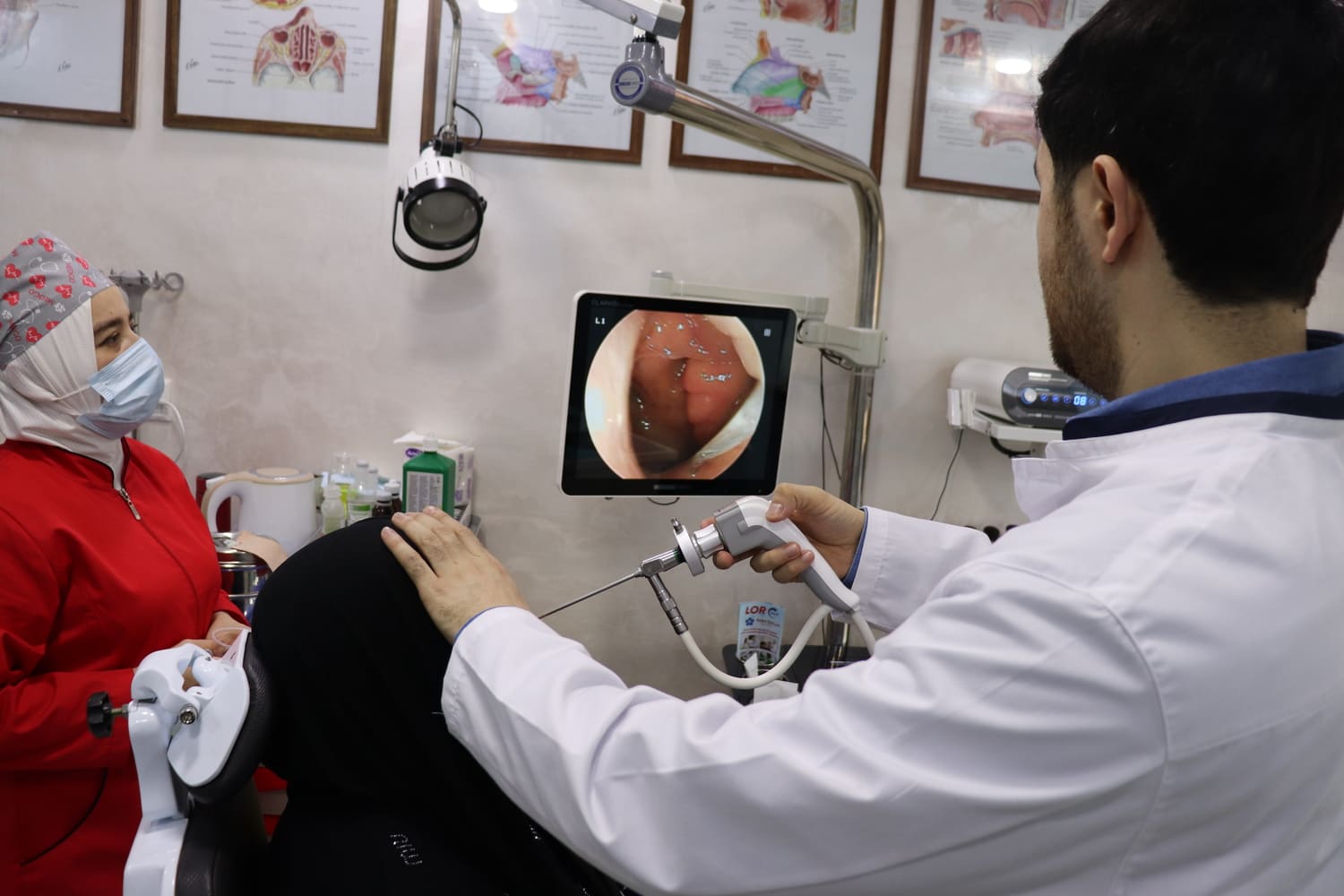
Assessment: otoscopy and a hearing test
The ENT doctor examines the ear with an otoscope or an ear endoscope, assessing the size, position and edges of the hole and whether there is inflammation in the middle ear. Then audiometry is done: it shows how much hearing has dropped and whether this is due to the eardrum alone or the hearing bones have also been affected. These tests are described in the article on hearing tests. In long-standing disease a CT scan of the temporal bones is sometimes needed as well.
Will it heal by itself or is surgery needed?
Small traumatic perforations often heal on their own within a few weeks — the key is to keep the ear dry and prevent infection. A hole caused by acute otitis also closes in many cases once the infection has been treated. A perforation that has not healed within about 3 months, however, usually will not close by itself.
| Often heals by itself | Usually needs surgery |
|---|---|
| A fresh, small hole caused by injury | A hole that has not healed for more than about 3 months |
| A hole after acute otitis, with the infection treated | Chronic otitis with recurrent ear discharge |
| Hearing slightly reduced and improving | Hearing clearly reduced |
| Clean edges, no infection | A large or marginal hole, or suspected cholesteatoma |
When tympanoplasty is needed and how it is done
Tympanoplasty is an operation to repair the eardrum. The hole is closed with the patient’s own tissue — usually the fascia of a muscle near the ear, or cartilage. The operation is done under a microscope or an endoscope, often through the ear canal. If the hearing bones are also damaged, they are reconstructed at the same time; this is called ossiculoplasty. There is more detail in the article on tympanoplasty. In children, problems caused by fluid collecting in the middle ear need a different approach — read about glue ear.
Recovery after tympanoplasty
- keep the ear dry — no water in the ear until the doctor allows it;
- do not blow your nose hard, and sneeze with your mouth open;
- for several weeks avoid flying, diving and heavy lifting;
- the dressing in the ear canal is removed by the doctor at a follow-up visit;
- hearing usually improves gradually over several weeks; the final result is assessed with audiometry.
Whether it is safe to wait or an operation is needed can only be decided by an ENT doctor after an examination and hearing tests. You can read more on the page of our ENT department.
Frequently asked questions
Does a perforated eardrum heal by itself?
Often, yes: small traumatic holes heal within a few weeks. A perforation that has not healed in about 3 months usually will not close on its own and may need surgery.
How do I know if my eardrum has burst?
Typically, after severe pain, fluid runs from the ear and the pain eases; hearing drops and there may be ringing in the ear. An ENT examination gives a definite answer.
Can I use ear drops with a perforated eardrum?
Only drops prescribed by a doctor. Some drops can pass through the hole into the middle ear and cause harm.
Can I shower with a perforated eardrum?
Yes, but put cotton wool coated with petroleum jelly in the ear to keep water out. Swimming and diving should wait until the hole has healed.
When is tympanoplasty done?
When the hole has not healed in about 3 months, when there is chronic discharge from the ear or when hearing is clearly reduced. The ENT doctor decides after an examination and audiometry.
When can I fly after tympanoplasty?
A wait of several weeks is usually advised. The doctor will give the exact timing after a follow-up visit.
Does a perforated eardrum cause complete hearing loss?
Usually not — hearing is more often partly reduced and improves once the eardrum heals or is repaired. If hearing is lost suddenly and severely, see a doctor straight away.
Related reading:
Doctors for consultation
Eardrum perforations are assessed and treated by our ENT doctors, who perform tympanoplasty when needed. Our doctors in this field:




Book an appointment with an ENT doctor
Fluid from the ear or reduced hearing after an injury? Ear endoscopy shows a perforation within minutes.
Call now — +998 71 210-30-30Contacts
Address: 7A/3 Nurafshon street, Tashkent
Phone: +998 71 210-30-30 · WhatsApp: +998 95 662-30-30
Opening hours: Monday–Saturday, 09:00–18:00
E-mail: