


Useful articles

Otosclerosis: Hearing Loss, Diagnosis and Stapedotomy Surgery
Doctor's blog
sbdrmn
Direction: Robotic surgery · All services
Otosclerosis is a condition in which abnormal bone grows around the stapes in the middle ear, fixing it in place and causing hearing to decline gradually. It most often affects young adults, particularly women and people with a family history. Below we explain the symptoms, how otosclerosis is diagnosed, the options of observation, hearing aids and stapedotomy surgery, the risks involved and what recovery looks like.
Contents
What otosclerosis is: how the stapes becomes fixed
The middle ear contains three tiny hearing bones: the malleus, the incus and the stapes. Together they carry vibrations from the eardrum to the inner ear. Otosclerosis is abnormal remodelling of bone in the part of the temporal bone that surrounds the inner ear. Most often the new bone grows around the base (footplate) of the stapes and fixes it in place. The stapes can no longer vibrate, sound does not reach the inner ear properly, and conductive hearing loss develops.
In some patients the process also affects the inner ear itself, and sensorineural (nerve-related) hearing loss is added. Otosclerosis usually progresses slowly over years; it often starts in one ear and later affects the other.
Who gets otosclerosis?
- Young adults — symptoms often begin between the ages of 20 and 40.
- Women — it is more common in women than in men.
- Family history — the risk is higher if close relatives have otosclerosis.
- Pregnancy — hearing loss sometimes progresses faster because of hormonal changes.
The exact cause is not fully understood; genetic, hormonal and other factors are being studied.
Symptoms of otosclerosis
- gradual hearing loss — people first struggle with quiet speech and whispers, and start turning the television up;
- tinnitus — often a low-pitched hum or buzzing;
- hearing better in noisy places — because others raise their voices, conversation on public transport or in the street can seem easier;
- your own voice sounds louder inside your head, so many patients speak quietly;
- less often — mild dizziness or unsteadiness.
Ear pain and discharge are not typical of otosclerosis. If they are present, other causes are looked for, such as an ear infection or a perforated eardrum.
How otosclerosis is diagnosed
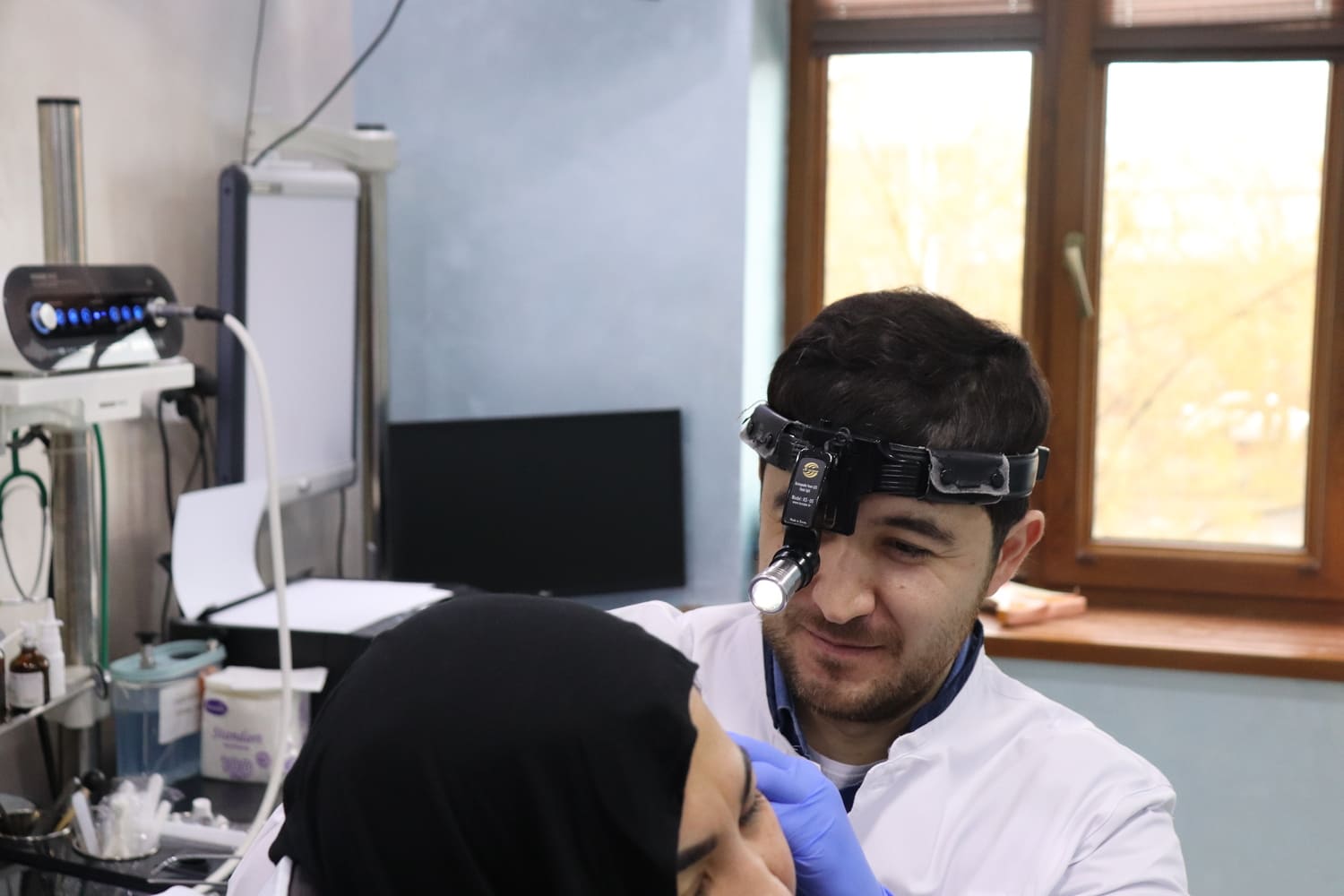
In otosclerosis the ear usually looks normal from the outside: the eardrum is intact and moves well. For this reason hearing tests play the key role in diagnosis:
- Otoscopy — examining the ear canal and eardrum to rule out other causes.
- Tuning fork tests — a simple comparison of how sound travels through air and through bone.
- Audiometry — a gap between the air-conduction and bone-conduction thresholds (the air-bone gap) points to conductive hearing loss.
- Tympanometry — usually a normal or slightly reduced trace, confirming that there is no fluid in the middle ear.
- Acoustic (stapedial) reflex — usually absent in otosclerosis, because the stapes cannot move.
- CT scan of the temporal bones — when needed, especially before surgery or when the diagnosis is uncertain.
How these tests are carried out is described in detail in the article on audiometry and tympanometry.
Treatment options: observation, a hearing aid or surgery
There is no medicine that can “dissolve” otosclerosis or make the stapes move again. The approach is chosen according to how much hearing has been lost, the patient’s age, the state of the other ear and the patient’s own preferences.
| Option | Who it suits | Advantages | Limitations |
|---|---|---|---|
| Observation | Mild hearing loss that does not interfere with daily life | No intervention at all | Regular audiometry is needed; hearing may slowly get worse |
| Hearing aid | People who do not want surgery or for whom it is not suitable | Safe, non-surgical, can be started at any time | Needs to be worn daily, maintained and adjusted |
| Surgery (stapedotomy or stapedectomy) | Significant conductive hearing loss with a large air-bone gap | Hearing improves noticeably in most patients, often without the need for an aid | Carries surgical risks; the result cannot be predicted with certainty |
How stapedotomy is done
Stapedotomy is one type of surgery on the hearing bones (in the broad sense it belongs to ossiculoplasty). Working under a microscope, usually through the ear canal, the surgeon gently lifts the eardrum and reaches the fixed stapes. The upper part of the stapes is removed, a tiny opening is made in its footplate and a miniature prosthesis (piston) is placed into it. The prosthesis is attached to the incus and once again carries sound vibrations into the inner ear. In a stapedectomy a larger part of the footplate is removed. The operation is done under local or general anaesthetic; the surgeon chooses the technique after the assessment.
The worse-hearing ear is usually operated on first. The second ear, if needed, is considered only after the result of the first operation has been assessed. Repairing the eardrum itself is a different operation — tympanoplasty — and it is not usually needed in otosclerosis.
Risks of surgery: an honest view
Stapedotomy gives a good result in most patients, but like any operation it carries risks:
- sensorineural hearing loss — uncommon but the most serious complication; very rarely, hearing in the operated ear can be lost completely;
- dizziness — common in the first few days and usually settles;
- a change in taste — a metallic or unusual taste on one side of the tongue, because a taste nerve runs through the ear; it often improves over a few months;
- tinnitus that becomes louder or persists;
- a hole in the eardrum or displacement of the prosthesis — occasionally a second operation is needed;
- injury to the facial nerve — very rare.
If after surgery your hearing suddenly gets much worse, or you develop increasing severe dizziness with vomiting, a high fever or weakness on one side of the face, contact your surgeon immediately. If you feel seriously unwell, call 103 without delay.
Recovery after stapedotomy
- for several weeks avoid flying, diving and heavy lifting;
- do not blow your nose hard, sneeze with your mouth open and avoid straining;
- keep the ear dry — no water in the ear until the doctor allows it;
- avoid sudden head movements and walk carefully in the first few days;
- the dressing in the ear canal is removed by the doctor at a follow-up visit;
- hearing usually improves gradually over several weeks, and the result is assessed with audiometry.
Whether observation, a hearing aid or surgery is right for you is decided together with your ENT doctor after an examination and hearing tests. You can read more on the page of our ENT department.
Frequently asked questions
What is otosclerosis and is it dangerous?
Otosclerosis is a condition in which the stapes loses its movement and hearing gradually declines. It is not life-threatening, but without treatment the hearing loss can keep getting worse.
Can otosclerosis be treated with medicine?
No medicine can make the stapes move again. Hearing is improved with a hearing aid or surgery, and the doctor recommends an option after the assessment.
What tests are needed for otosclerosis?
The main tests are audiometry, tympanometry and testing of the acoustic reflex. A CT scan of the temporal bones is done when needed.
How soon does hearing improve after stapedotomy?
Hearing most often improves gradually over several weeks. The final result is assessed with a follow-up hearing test.
Is stapedotomy risky?
Most patients get a good result, but there are risks: temporary dizziness, a change in taste and, uncommonly, sensorineural hearing loss. The surgeon explains these in detail before the operation.
Does pregnancy affect otosclerosis?
In some women hearing loss can progress faster during pregnancy. If you have otosclerosis, it is helpful to discuss pregnancy planning with an ENT doctor.
When can I fly after ear surgery for otosclerosis?
A wait of several weeks is usually advised. The surgeon will give the exact timing after a follow-up visit.
Related reading:
Doctors for consultation
Otosclerosis is diagnosed by our ENT doctors using hearing tests, and they advise on observation, hearing aids or surgery. Our doctors in this field:



Book an appointment with an ENT doctor
Is your hearing slowly getting worse? An examination and audiometry help find the cause and choose the right option.
Call now — +998 71 210-30-30Contacts
Address: 7A/3 Nurafshon street, Tashkent
Phone: +998 71 210-30-30 · WhatsApp: +998 95 662-30-30
Opening hours: Monday–Saturday, 09:00–18:00
E-mail: