


Useful articles

Prostate and Bladder Ultrasound: Abdominal or TRUS, Residual Urine and Preparation
Doctor's blog
sbdrmn
Direction: Robotic surgery · All services
A prostate and bladder ultrasound is one of the most common tests for men with urinary symptoms. It shows the size of the prostate, the state of the bladder and how much urine remains after voiding. Below: how an abdominal scan differs from TRUS, what is measured, why residual urine matters, how to prepare, and what ultrasound cannot show.
Contents
- Why a prostate ultrasound is done
- Two approaches: through the abdomen and TRUS
- What is measured on the scan
- Residual urine: what it is and why it matters
- How to prepare for a prostate ultrasound
- PSA and ultrasound: one does not replace the other
- When to see a urologist without delay
- Frequently asked questions
Why a prostate ultrasound is done
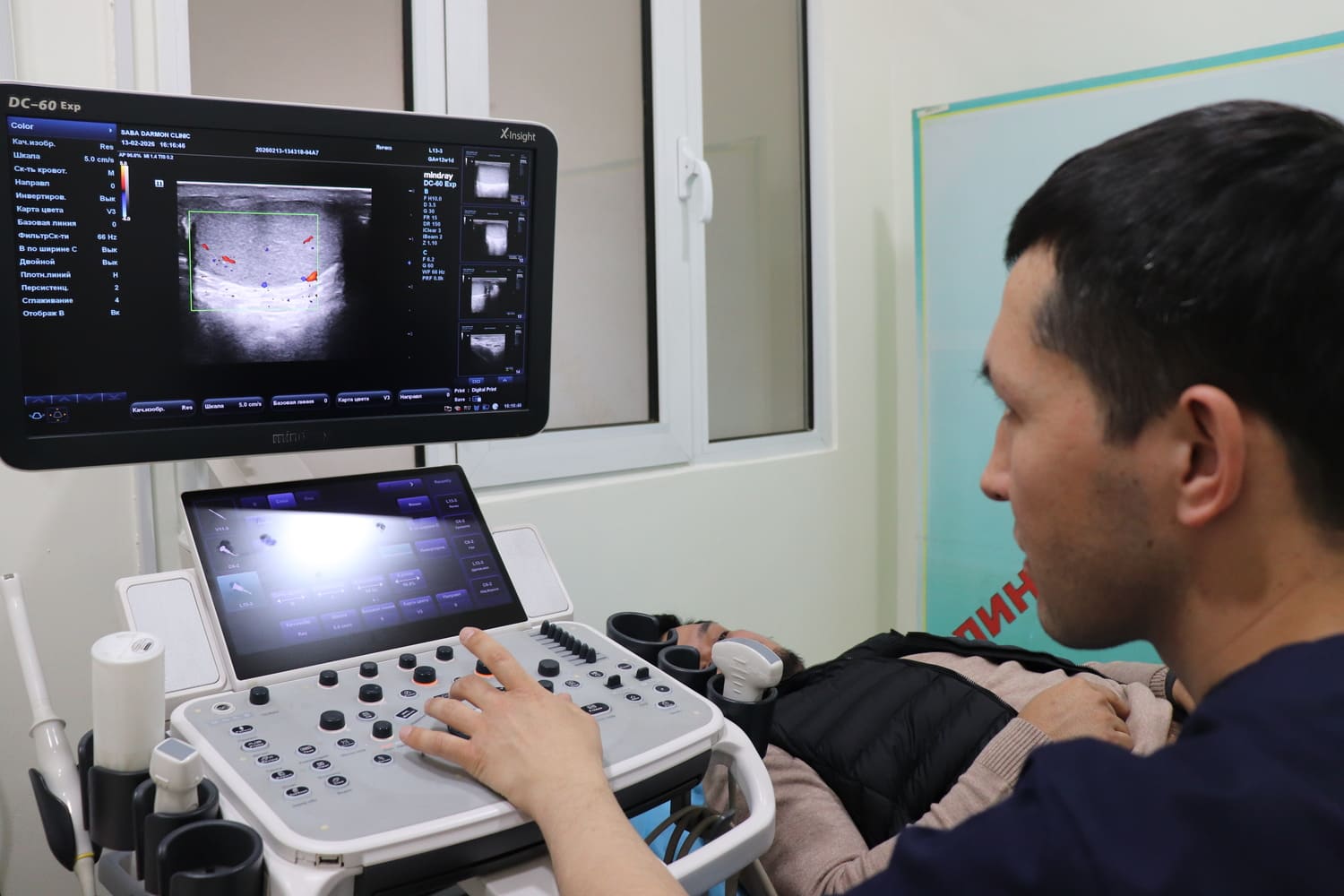
Frequent urination, getting up several times at night, a weak stream or the feeling that the bladder has not emptied completely are the most common reasons men see a urologist. With these symptoms, one of the first tests is a prostate and bladder ultrasound. It shows the size of the prostate, any nodules inside it, the bladder wall, stones and how much urine is left in the bladder after passing water. The scan is painless, involves no radiation and does not take long.
Two approaches: through the abdomen and TRUS
The prostate can be examined in two ways. In a transabdominal ultrasound the probe is placed on the lower abdomen, and the full bladder acts as a "window". In TRUS (transrectal ultrasound) a slim probe is inserted into the rectum; because the prostate lies right next to it, the image is much more detailed. TRUS is slightly uncomfortable but usually painless and takes only a few minutes.
| Criterion | Transabdominal ultrasound | TRUS |
|---|---|---|
| Probe position | On the skin of the abdomen | Through the rectum |
| Preparation | A full bladder | Usually emptying the bowel (the doctor will explain) |
| What it shows well | Prostate volume, bladder, residual urine, together with the kidneys | Prostate structure, small nodules, seminal vesicles |
| When it is chosen | First assessment, follow-up over time | When an exact volume is needed, a nodule is seen or PSA is raised, before surgery |
| Discomfort | Almost none | Brief discomfort |
Which approach is needed is decided by the urologist or the ultrasound doctor based on your symptoms and previous results. In many cases a transabdominal scan is enough.
What is measured on the scan
- Prostate volume — in millilitres (ml or cm³). In younger men it is approximately 20–25 ml; with age the prostate often grows. Volume on its own is not a diagnosis — it is interpreted by the doctor together with symptoms and other findings.
- Nodules and structure — calcifications, cysts, uneven areas.
- Bladder wall — thickening may point to a long-standing obstruction to urine flow.
- Stones and diverticula — stones in the bladder or "pockets" in its wall.
- Residual urine — the volume of urine left in the bladder after voiding.
Residual urine: what it is and why it matters
A healthy bladder empties almost completely when you pass water. If an enlarged prostate squeezes the urethra, the bladder cannot empty fully and some urine stays behind. The more residual urine there is, the higher the risk of infection, bladder stones and, over time, back-pressure on the kidneys. That is why this figure carries weight when choosing treatment — medication or surgery. Prostate enlargement is covered in detail in the article on benign prostatic hyperplasia.
How to prepare for a prostate ultrasound
- About 1 hour before the scan, drink 1–1.5 litres of water or a still drink and do not pass urine — the bladder needs to be full.
- First the prostate and bladder are examined with the bladder full.
- Then you will be asked to go to the toilet, after which the residual urine is measured.
- If TRUS is planned, the doctor will give separate instructions on bowel preparation.
General ultrasound preparation rules will be explained at booking. A kidney ultrasound is often done at the same visit: long-standing obstruction can cause the kidneys to dilate, and stones or signs of pyelonephritis can also be seen.
PSA and ultrasound: one does not replace the other
Ultrasound does not diagnose prostate cancer on its own. Cancerous nodules may not be visible on ultrasound, and not every visible nodule is cancer. That is why the urologist looks at the PSA blood test, a digital rectal examination and, if needed, an MRI together. Only a biopsy confirms the diagnosis.
When to see a urologist without delay
Being unable to pass urine (acute urinary retention), an overfilled bladder with severe lower abdominal pain, or painful urination with fever and shivering is an emergency — see a doctor at once or call 103. Do not put off a visit if you see blood in your urine either — read about blood in the urine.
The urologist interprets the results together with your symptoms and tests. Our ultrasound service and urology department have their own pages.
Frequently asked questions
How do I prepare for a prostate ultrasound?
About an hour before the scan drink 1–1.5 litres of water and do not pass urine. The first part is done with a full bladder, then residual urine is measured after you have been to the toilet.
What is a normal prostate volume?
In younger men approximately 20–25 ml. The prostate often grows with age; the urologist interprets the result together with your symptoms.
Is TRUS painful?
It is usually painless, with only brief discomfort. The probe is slim and the test takes a few minutes.
How much residual urine is a problem?
A small amount often does not matter, while a large amount raises the risk of infection and stones. The urologist decides how significant your figure is in the light of your symptoms.
Can ultrasound detect prostate cancer?
Not on its own. Ultrasound may show a suspicious area, but the diagnosis needs PSA, an examination, an MRI if required and a biopsy.
Should the kidneys be scanned together with the prostate?
Often, yes. Long-standing obstruction can make the kidneys dilate, and a kidney scan also shows stones and signs of inflammation.
Related reading:
Doctors for consultation
Prostate and bladder ultrasound is performed by our ultrasound doctors and interpreted by our urologists. Our doctors in this field:





Book a prostate and bladder ultrasound
Troubled by frequent urination or a weak stream? An ultrasound and a urologist’s assessment help find the cause.
Call now — +998 71 210-30-30Contacts
Address: 7A/3 Nurafshon street, Tashkent
Phone: +998 71 210-30-30 · WhatsApp: +998 95 662-30-30
Opening hours: Monday–Saturday, 09:00–18:00
E-mail: